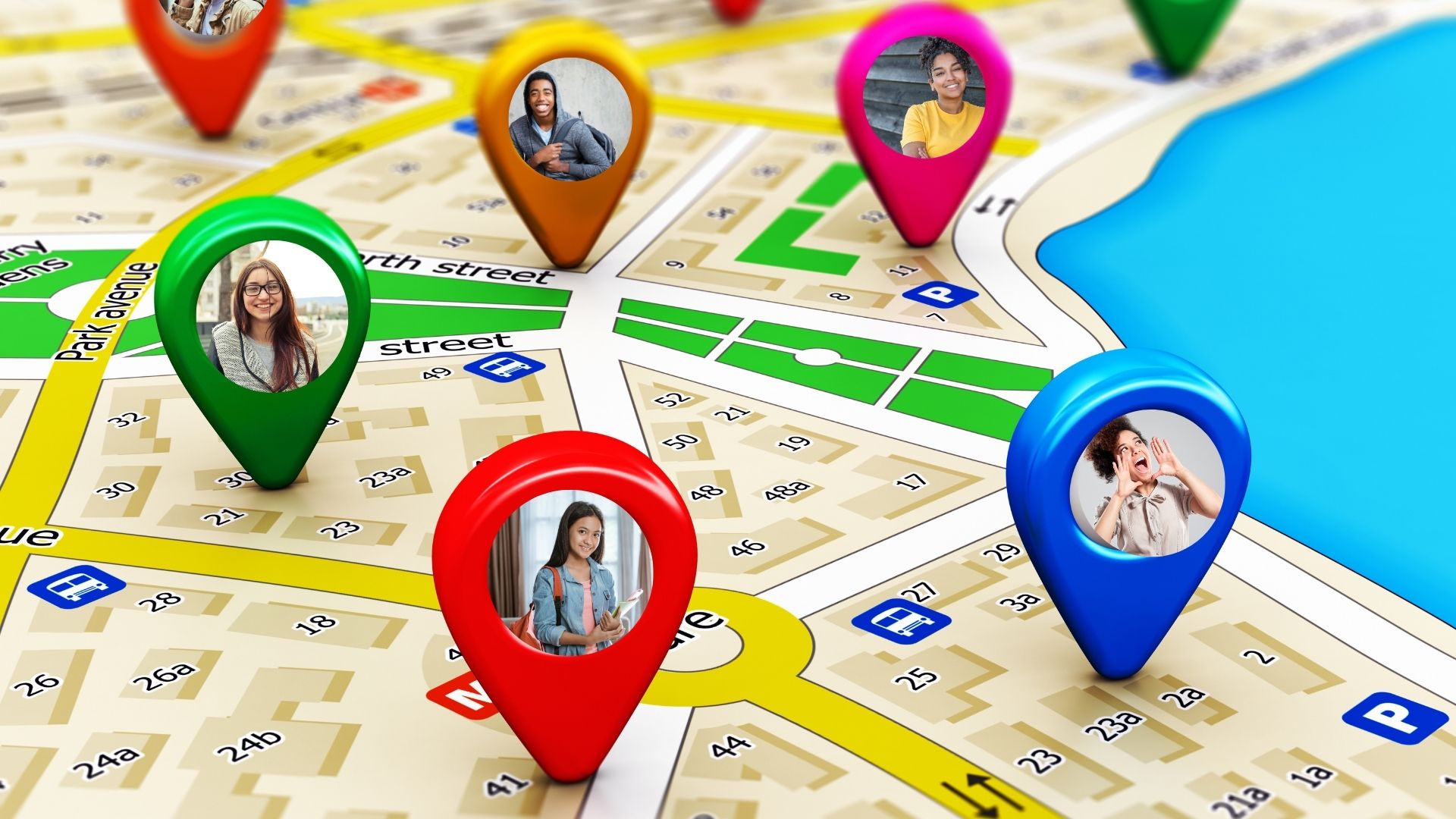
Location sharing can enhance connection and feelings of safety, but raises questions about privacy, personal boundaries, and what it means to be constantly visible.
Key Points
- Location sharing has become a sign of closeness and belonging among young people.
- Tracking friends creates an ambient awareness that delivers feelings of connection, comfort, and support.
- Location sharing also creates new opportunities for social comparison, FOMO, and digital drama.
- 5 tips to help your teen keep their location sharing healthy and effective.
Why Teens Love Location-Sharing
It’s been six years since I wrote about the impact of location-sharing apps on trust and relationships. Six years is a long time when it comes to technology. In those years, location tracking has become the norm, especially among Gen Z. What started as a tool for oversight, safety, and convenience has expanded to become a form of social glue used to coordinate plans, see who’s out and about, or to simply feel included. Even though it’s virtual, seeing friends’ dots move around a map can give a sense of closeness and comfort. Watching others’ routines and activities can create a sense of intimacy that strengthens bonds even when there’s no practical need. The ambient awareness of seeing friends’ locations delivers the warm, fuzzy feelings associated with social connection and support. It’s no wonder it’s popular, but location-sharing can come at a price.
Safety remains the most frequently cited reason for using location tracking. Parents often feel that knowing a child’s location provides a ‘safety net.’ Life360, a cross-platform app that dominates the family safety and location-sharing market, estimates that about 10% of U.S. families track the real-time locations of family, friends, or other groups using GPS. Another popular app, FindMy, operates exclusively within the Apple ecosystem but is particularly popular among teens because it’s free on all Apple devices. Life360 is a paid subscription service if you want anything other than basic location tracking.
Location-sharing has been around in one form or another for over 15 years, so the parents of today’s 18-year-olds have been able to track their kids since they got their first mobile devices. This may help explain why the adoption of location-sharing in general, and the acceptance of Life360 in particular, is so high among Gen Z. They have grown up being tracked through location sharing. Teens often view parental monitoring as the “price” of freedom, although many also take comfort knowing that their parents are keeping a watchful eye.
Sharing for Safety and Social Connection
Find My and Life360 have helped normalize location sharing, but the emergence of Snap Map was the tipping point from safety to social. Snap Map was designed as a social discovery platform to make location sharing fun, visual, and integrated with social media content. According to Life360 (2023), over 75% of teens actively use location-sharing apps and 95% of Gen Z say that location sharing benefits their life. Most teens cite the benefits of location-sharing as making them feel safe, especially young women, but it has evolved into a means of communicating and showing affection among friends. Life360 argues that location sharing has prompted Gen Z to embrace a new culture of safety among friend groups. There may be truth in this, but the real driver is social.
The convenience of knowing your friends’ locations has turned location-sharing into a symbol of relationship status. Some kids report that location sharing is expected among close friends or romantic relationships. And while sharing locations can feel like a gesture of trust, many report that it’s just fun to know where your friends are.
Visibility Triggers Comparison and FOMO
The apps now function as real-time social media platforms where young people can see not just where their friends are, but what kind of lives they’re living. This creates new opportunities for FOMO, social comparison, and digital drama that extend beyond traditional social media posts.
For adolescents, who are developmentally wired for social comparison and identity exploration, seeing friends out without you can trigger feelings of exclusion or inadequacy. Because everyone can see each other’s movements, teens may feel pressured to appear social, even if they are not, just to avoid looking isolated or unpopular.
Social Pressure to Share
When everyone shares their location, not sharing can be perceived as secrecy, avoidance, or even a lack of trust, creating peer pressure to share, even when it is unwanted. Turning it off when there’s an expectation of access can cause conflict among friends. In romantic relationships, the meaning attached to visibility or invisibility can become a real minefield. Location sharing can cause distress and confusion when a relationship ends, and teens don’t know how to opt out. Unlike unfollowing someone on other social media platforms, turning off location is a visible action. Young people may feel they have no choice but to give constant access to maintain their social relationships, effectively trading privacy for a sense of belonging.
Support vs. Surveillance
Apps like Life360 provide detailed information, including arrival times, driving speed, and exact routes. This may appeal to worried parents, but it can also feel intrusive or controlling to teens, especially when done without consent.
Many have raised questions about how constant monitoring, even voluntary location sharing, may impact how we navigate our social environment. In one study, Seymour et al. (2024) found that being watched affected cognitive functions such as memory and attention, impacting consciously controlled behaviors and unconscious, involuntary visual processing. If we are training our brains to operate under the assumption of constant surveillance, what are the potential implications for things like creativity, risk-taking, and authentic self-expression?
Location tracking can also fuel digital arguments and create an expectation of instant accountability, shifting social norms about responsiveness and privacy. It also carries serious risks when tracking turns to an invasion of privacy, stalking, harassment, or coercion. Questions like “Why didn’t you respond?” or “Why weren’t you where you said you would be?” now come with location-based “evidence.”
Communication and Consent
Whether between friends or between parents and children, open communication and mutual consent are essential. Tracking a child without their knowledge turns even the best intentions into spying and can undermine trust and damage the parent–child relationship. Surveillance without consent often backfires. What’s appropriate oversight for a tween can be developmentally restrictive for a teen, sending them right to YouTube and TikTok for a tutorial on how to bypass tracking apps.
There are compelling examples of location-tracking saving the day, but knowing a teen’s location doesn’t guarantee safety. Knowing a location is no replacement for skills like decision-making, boundary setting, and situational awareness. We can help our kids by reinforcing that location sharing for any reason should be accompanied by conversations. And we have to be willing to be open-minded enough to have those conversations. After all, if the goal is to keep our kids safe, we need to encourage critical thinking about location sharing to help them think about the trade-offs, weigh the risks and benefits, make informed decisions about when and with whom they want to share, and learn strategies for opting out when it doesn’t feel right.
5 Ways to Keep Location Sharing Positive
- Acknowledge Benefits: Let your teens know that you understand the plus side and social aspects of location-sharing, such as coordinating plans, knowing what’s going on, feeling connected, or because it’s fun.
- Make Consent Intentional: Encourage periodic reassessment of location-sharing agreements rather than indefinite sharing arrangements.
- Suggest Context-Specific Sharing: Promote situational sharing (dates, late nights, travel) rather than constant monitoring.
- Highlight FOMO Awareness: Help teens recognize how location awareness can trigger social comparison behaviors or digital drama.
- Encourage Digital Boundaries: Help teens develop language and strategies for maintaining privacy and setting boundaries without damaging relationships.
References
Civic Science. (2025, April 14). How Location Sharing Is Shaping Connectivity Among Americans. https://civicscience.com/how-location-sharing-is-shaping-connectivity-among-americans
Life360. (2023, August 24). For Gen Z, (Location) Sharing Is Caring https://www.life360.com/blog/gen-z-location-sharing-study
Seymour, K., McNicoll, J., & Koenig-Robert, R. (2024). Big brother: The effects of surveillance on fundamental aspects of social vision. Neuroscience of Consciousness, 2024(1). https://doi.org/10.1093/nc/niae039

 Dr. Pamela Rutledge is available to reporters for comments on the psychological and social impact of media and technology on individuals, society, organizations and brands.