DR. PAM | MEDIA PSYCHOLOGIST
THE PSYCHOLOGY OF DIGITAL BEHAVIORS
  • Home
  • Blog
  • About
    • About Dr. Pamela Rutledge
    • Media Psychology
      • What Is A Media Psychologist?
      • 8 Reasons Why We Need Media Psychology
      • Careers in Media Psychology
      • Example Careers in Media Psychology
      • Media Psychology at Fielding Graduate University
      • Positive Media Psychology
    • MPRC
      • Media Psychology Research Center
    • Media Psychology Review
  • Consulting
    • Speaking & Consulting
    • Audience Engagement: Why Use Personas?
      • How to Build a Persona
    • Adapting to Change
    • Transmedia Storytelling
      • Storytelling Across Platforms
      • Transmedia Storytelling Starts with the Power of Story
      • Our Transmedia World
      • Transmedia Case Study: The Three Little Pigs
      • Transmedia Storytelling Workshop
  • Story Power
    • Brand Storytelling
    • Storytelling: Brands, Entertainment & Organizations
      • Storytelling for Organizations
      • Core Story: Case Study
  • In the News
    • Press Quotes & Interviews 2022-2025
    • 2021-2019
    • 2018-2016
    • 2016-2017
    • 2015-2013
    • 2012 & EARLIER
    • Video Interviews & Webinars
  • Resources
    • Mindful Media & Digital Literacy
      • Positive Media Psychology
      • Benefits of Video Games Part 1
      • Benefits of Video Games Part 2
      • Benefits of Video Games Part 3
      • Becoming Mindful: Exercises
      • Mindful Media Journal
    • Academic Materials
      • Media Psychology Syllabus 2021
      • Media Psychology Syllabus 2012
      • Media Psychology Syllabus 2015
    • Articles
      • Persuasion & Augmented Reality
      • Psychology of Transmedia Engagement
      • Theories of Attention
      • The Psychology of Color
      • Website Design: How to Use Psych Theory
      • Data Strategy: Listen to Your Consumers’ Stories
      • The Psychology of Story
  • Archives
  • Contact
DR. PAM | MEDIA PSYCHOLOGIST
  • Home
  • Blog
  • About
    • About Dr. Pamela Rutledge
    • Media Psychology
      • What Is A Media Psychologist?
      • 8 Reasons Why We Need Media Psychology
      • Careers in Media Psychology
      • Example Careers in Media Psychology
      • Media Psychology at Fielding Graduate University
      • Positive Media Psychology
    • MPRC
      • Media Psychology Research Center
    • Media Psychology Review
  • Consulting
    • Speaking & Consulting
    • Audience Engagement: Why Use Personas?
      • How to Build a Persona
    • Adapting to Change
    • Transmedia Storytelling
      • Storytelling Across Platforms
      • Transmedia Storytelling Starts with the Power of Story
      • Our Transmedia World
      • Transmedia Case Study: The Three Little Pigs
      • Transmedia Storytelling Workshop
  • Story Power
    • Brand Storytelling
    • Storytelling: Brands, Entertainment & Organizations
      • Storytelling for Organizations
      • Core Story: Case Study
  • In the News
    • Press Quotes & Interviews 2022-2025
    • 2021-2019
    • 2018-2016
    • 2016-2017
    • 2015-2013
    • 2012 & EARLIER
    • Video Interviews & Webinars
  • Resources
    • Mindful Media & Digital Literacy
      • Positive Media Psychology
      • Benefits of Video Games Part 1
      • Benefits of Video Games Part 2
      • Benefits of Video Games Part 3
      • Becoming Mindful: Exercises
      • Mindful Media Journal
    • Academic Materials
      • Media Psychology Syllabus 2021
      • Media Psychology Syllabus 2012
      • Media Psychology Syllabus 2015
    • Articles
      • Persuasion & Augmented Reality
      • Psychology of Transmedia Engagement
      • Theories of Attention
      • The Psychology of Color
      • Website Design: How to Use Psych Theory
      • Data Strategy: Listen to Your Consumers’ Stories
      • The Psychology of Story
  • Archives
  • Contact
Sep 11
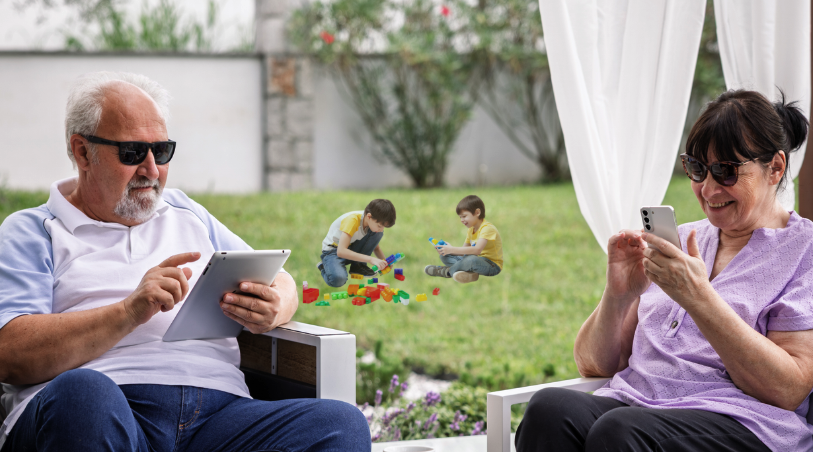
Your parents may seem as phone-absorbed as your teenagers, but their needs and motivations are different. Photo: AzmanL | Getty Images Signature; Jasmina Putnik | JRP Studio.

Are Grandparents the New “iPad Kids”?

  • September 11, 2026
  • Pamela Rutledge
  • No Comments

Managing teens’ tech use is hard enough. What happens when your parents join in?

Here’s how to address those frustrating digital habits without becoming the technology police.


Key Points

  • Social media exploits human attention across the lifespan; it’s not a weakness limited to any age group.
  • Technology can help older adults maintain social connection and a sense of belonging when their offline worlds get smaller.
  • Older adults need digital literacy skills to stay safe and understand the effect of technology use on those around them.

For decades, parents have been telling teenagers to get off their phones. Lately, though, frustrated adults on Reddit have started calling their parents the new “iPad kids” because their parents are now just as likely as their teens to scroll through social media during family gatherings, watch endless YouTube videos, or disappear into political and health-related rabbit holes. It’s tempting to take these reports as evidence that we should extend the same worries we have about kids and technology to older adults. Some adult children who already feel responsible for managing their kids’ technology use now feel like they have to police their parents, too.

What Does the Data Say?

The data tell a different story. Yes, older adults are adopting technology fast. Smartphone ownership among adults over age 50 rose from 55% in 2016 to 90% in 2025 (Kakulla, 2026). But adoption isn’t the same as compulsion. Just like with teens, not all screen time is equal. When researchers measure problematic internet use, older adults generally score lower than younger adults (Devine et al., 2022). For older adults, sitting around watching television is associated with poorer mental health than other types of screen use (Silva Santos et al., 2026). By contrast, older adults who use technology report being more socially engaged (Lee et al., 2026). None of this makes it any less frustrating when your parents are glued to their devices while they are supposed to be spending time with you or your kids.

Why Grandma Keeps Scrolling

Getting sucked into perpetual scrolling is a human attention problem, not an aging problem. Infinite scroll, autoplay, notifications, and algorithmic recommendations eliminate natural stopping points and continually offer something new. Those mechanisms work across the lifespan.
There are, however, age-specific changes like retirement, which can suddenly remove the structure that organized someone’s days for decades. Social networks can shrink. Friends move away or die. Adult children have busy lives of their own. Mobility may decrease, leaving more unstructured time to fill. Where teens are motivated to meet developmental needs for peer connection, older adults face different developmental tasks. They face the work of adjusting to physical changes, redefining identity after retirement, coping with loss, and finding living arrangements where they can maintain independence and safety. Aging doesn’t mean they want to detach emotionally or cognitively, and technology can help them stay connected and informed, contribute to others, and feel that they still matter.

Old Habits, New Screens

Older adults over age 65 still watch a lot of television. They rely on it for entertainment but also for a sense of companionship to ease loneliness (Depp et al., 2010). Thanks to portability and ease of use, older adults are now also adding mobile devices to their media consumption, particularly for communication and information (Gallo et al., 2024). But adopting mobile technology does not guarantee digital etiquette. Television can become a shared experience. A smartphone directs one person’s attention away from everyone else. Older adults may feel they are being social when they look at grandchildren’s photos, message friends, or catch up with a community online. To the person sitting next to them, however, the behavior can communicate something very different. It says: “You’re paying attention to your device instead of me.” And, like everyone else, older adults are vulnerable to habit formation. Apps are designed to grab and hold attention using notifications and infinite scrolling. An older adult can fall into the exact same unconscious scrolling habits as anyone else, completely unaware of how much time has passed or how it looks to others.

Sandwiched Between Smartphones

It’s easy to let frustration drive you toward wanting to control your parents’ technology use rather than understand it. One moment you’re troubleshooting passwords or explaining what to do with a suspicious email. The next, you can’t understand why they won’t put down the phone when they came over to see the grandchildren. This is a different role from parenting your kids. With your parents, you are caught between parent and child roles, balancing feeling responsible for helping them navigate a complicated digital environment with respect for their independence and autonomy, while also protecting your own boundaries. Like your kids, older adults need digital literac. But but they don’t need their adult children imposing the same strategies they use with kids. Older adults need information and tools that help them make their own decisions, from understanding how recommendation algorithms work to recognizing scams, evaluating online information, and knowing when to ask for help. They also often face design barriers. Small text, complicated navigation, unfamiliar icons, and changing interfaces can demand more concentration and time, making someone appear completely absorbed even when they are trying to accomplish a simple task. Many older adults learned their digital media habits before algorithms could adapt to online behavior and build predictive profiles, much less customize what shows up in their feeds and email in ways that influence how they see the world. Targeted content takes advantage of the major shifts that come with aging, challenging a person’s sense of and making them vulnerable to information and groups that offers identity and belonging. Dealing with relational and physical loss can increase the appeal of content that inflames outrage at what was “taken away.” Aging can also increase the appeal of nostalgic content that provides continuity and meaning and validates a longing for “the good old days.”

Before You Unplug the Wi-Fi

Before you resort to turning off the Wi-Fi, confiscating mobile devices, or installing parental control apps on your parents’ phones, start with a conversation about what your parents like or are getting from their technology. Some people follow the news to feel informed, satisfying a need for competence and clarity. Others follow it to quiet their fear and anxiety. Understanding the psychological value someone receives from technology use makes it easier to distinguish a safety or skills problem from a relationship problem. This allows you to negotiate boundaries with compassion rather than without turning device use disagreements use into battles. If you want to encourage different technology behaviors:
  • Focus on connection, not rules. Physical presence isn’t the same as emotional presence. Emphasize the effect on the grandkids when grandparents are absorbed in their phones rather than interacting with them.
  • Translate the behavior that bothers you into their familiar social norms. Someone who doesn’t understand why using a phone around others is a problem may relate to a parallel situation using a more familiar form of media, like reading the newspaper at the breakfast table instead of talking with the family.
  • Explain the attention shift. Even looking away to check one message can derail an in-person interaction, especially when it leads to another notification, link, or post.
  • Make solutions family-wide. “We like everyone to turn their phones off at the dinner table” works better than “Mom, turn your phone off.”
These conversations create an opportunity for perspective-taking on both sides. Your parents can better understand how their device use affects you and the behaviors you want modeled for your kids and you may better understand what technology is providing for them. You don’t have to become the technology police for two generations. The goal is the same for both: using technology safely and intentionally in ways that support relationships and well-being. With kids, you are building skills and judgment so you can gradually transfer responsibility as they mature. With parents, you are supporting their autonomy by balancing respect and understanding with safety.

References

Depp, C. A., Schkade, D. A., Thompson, W. K., & Jeste, D. V. (2010). Age, affective experience, and television use. Am J Prev Med, 39(2), 173–178. https://doi.org/10.1016/j.amepre.2010.03.020 Devine, D., Ogletree, A. M., Shah, P., & Katz, B. (2022). Internet addiction, cognitive, and dispositional factors among US adults. Computers in Human Behavior Reports, 6, 100180. https://doi.org/10.1016/j.chbr.2022.100180 Gallo, A. M., Araujo, J. P., Baccon, W. C., Marques, F., Salci, M. A., & Carreira, L. (2024). Smartphone use by older adult in the healthy ageing process: A theory based on data. Rev Lat Am Enfermagem, 32, e4383. https://doi.org/10.1590/1518-8345.7252.4383 Kakulla, B. (2026). Tech use and adoption keeps surging among older adults. AARP. Retrieved July 20, 2026, from https://www.aarp.org/pri/topics/technology/internet-media-devices/2026-technology-trends-older-adults/ Lee, J., O’Shields, J., & Dunnigan, A. (2026). The role of technology use and employment status in shaping social engagement among older americans. Journal of Applied Gerontology, 45(6), 1125–1135. https://doi.org/10.1177/07334648251369265 Silva Santos, R. M., Ventura, S. d. A., Nogueira, Y. J. d. A., Mendes, C. G., Miranda, D. M. d., & Romano-Silva, M. A. (2026). The associations between screen time and mental health in older adults: A systematic review. Behaviour & Information Technology, 45(10), 1989–2006. https://doi.org/10.1080/0144929X.2025.2564366
  • Facebook
  • Twitter
  • Reddit
  • LinkedIn
  • E-Mail

About The Author

Pamela Rutledge, PhD, MBA is the Director of the Media Psychology Research Center. A consultant, author, speaker, and professor, she consults on a variety of media projects developing audience engagement and brand storytelling strategies.

Leave a reply

Your email address will not be published. Required fields are marked *

This site uses Akismet to reduce spam. Learn how your comment data is processed.

FOR THE PRESS

Dr. Pam Rutledge, media psychologistDr. Pamela Rutledge is available to reporters for comments on the psychological and social impact of media and technology on individuals, society, organizations and brands.  pamelarutledge@gmail.com

SEARCH THE SITE

RECENT POSTS

  • Can Crowdsourcing Fix Dating Apps?
  • Are Grandparents the New “iPad Kids”?
  • The Popularity of “Dopamine Sites” Shows the Emotional Pay-off of Fake Food Orders
  • We Didn’t Prepare Kids for Social Media: Will We Do Better with AI?
  • Do You Want Your Kids Arguing Like a Politician?

MEDIA PSYCHOLOGY RESEARCH

The Media Psychology Research Center (MPRC) is an independent research organization directed by Dr. Pam Rutledge.  Read about MPRC at www.mprcenter.org.

CONSULTING PROJECTS

Dr. Rutledge consults on a variety of media projects using psychology to translate data into human behavior for powerful results.

  • Parenting in a Digital World webinar series
  • Persona Development for audience segmentation
  • Fan and Audience Engagement: Identifying audience narratives to satisfy needs
  • Brand Storytelling: Supercharging brand meaning

RECENT POSTS

  • Can Crowdsourcing Fix Dating Apps?
  • Are Grandparents the New “iPad Kids”?
  • The Popularity of “Dopamine Sites” Shows the Emotional Pay-off of Fake Food Orders
  • We Didn’t Prepare Kids for Social Media: Will We Do Better with AI?
  • Do You Want Your Kids Arguing Like a Politician?

SEARCH

Content copyright Pamela Rutledge 2026.