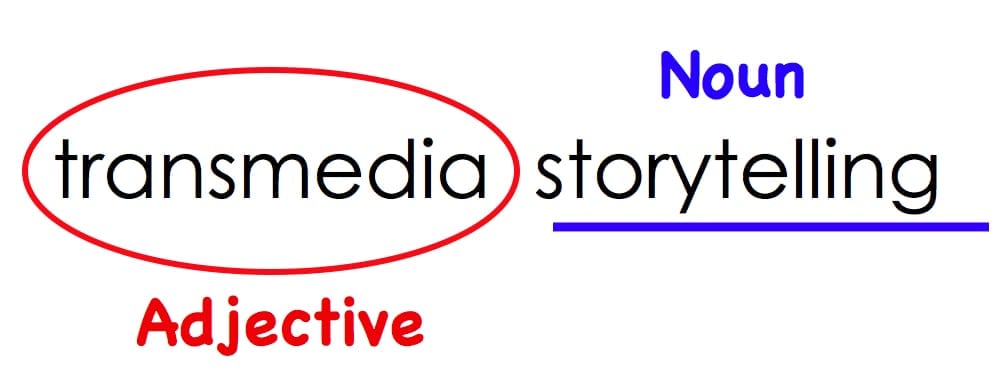
We need a new name for ‘transmedia storytelling’. It seems like all the excitement about big transmedia storytelling projects has made it the buzz term du jour. But somehow, in all that excitement, the fundamentals have become obscured. It’s important to remember that in ‘transmedia storytelling,’ that ‘transmedia’ is an adjective. ‘Storytelling’ is the noun.
 The transmedia part of transmedia storytelling is like building a musical score the way a conductor employs different instruments in an orchestra. Each instrument doesn’t sound the same or play the same notes but if performed well, is beautiful on its own. Together they create a whole new experiential space that transports us by opening the door to our emotions and imagination. Transmedia storytelling, like a symphony, creates a collaborative and immersive story ecosystem that is new, engaging, and exciting. It takes tremendous creativity, talent, and, literally, orchestration, to pull off a transmedia storytelling project. But the created storyworld, for all the technological marvels, trick applications, and clever alternate reality games, is only as effective as the story it is built on.
Storytelling is a basic and powerful form of communicating. Narrative is how humans have always shared information because it includes context and emotion. Stories are cognitively linear so they can describe a path of events with a goal, a conflict, and the promise of resolution. This doesn’t mean that stories can’t be constructed in a nonlinear environment. They can; that’s part of the excitement about using the tools of a transmedia world to assemble the story. But the linear link is what provides coherency so that the parts fit together, whether it’s backstory or clues to unravel mysteries in the main story arc. 
Stories are how the brain communicates. Human brains are hardwired to look for patterns and causality. It’s how we discriminate between a tiger and a tree. Once the brain identifies a pattern, such as a ‘tall thing with leaves’ or ‘striped animal with big teeth,’ it has to make a split second judgment as to whether the detected information is something safe or dangerous so we can react. In other words, the brain uses the pattern-finding information to match against existing experiences — the ‘story’ of sensory information that links events and information together — in order to trigger the emotional and behavioral responses that increase our probability of survival.
The more emotion involved in the experience, the more we pay attention and the better we remember it. Emotion, both positive and negative, was a signal of importance to our survival: “the last time I saw a tiger it ate the antelope…therefore, I will run” or “I really love this baby, therefore I will take care of it.”
Controlling our environment was a sure way to survive. This is why humans are curious. In a modern world, curiosity doesn’t always have such a directly apparent relationship with survival. However, it is still true that the more we know, the better we can predict and the more we have certainty, the more cognitively comfortable we are. Mastering challenges, overcoming the unknown, and conquering uncertainty were essential elements of survival on the Savannah. They still feel really good today. The fact that we’re wandering around in cyberspace doesn’t diminish the human drive to find things out and conquer uncertainty, or the primordial (or neural) pleasure in doing so. It’s just what we do.
Stories are games without points or scores. They engage us because they trigger our curiosity, for example, how many bad movies have you watched to see how they end? A good story, however, gives us authentic emotion and a universality that allows us to connect in a multisensory way. A good story transports us into a new experience. A good story creates personal growth.
Transmedia storytellers have the full pallet of media at their disposal to construct a story within a rich fabric of experience. The wealth of media technologies allows for the integration of interactive and sharable qualities. The result when done well is a story that moves across media and transcends on and offline space. This is only possible because technology has moved the locus of control to the players. The stories only move across media and across time and space when the audience decides to carry it. Transmedia storytelling creates a collaborative and immersive environment that is new, engaging, and exciting…and participation-dependent. Aspiring transmedia producers need to remember that the created environment, for all the available technological intricacies and opportunities, is only as effective as the story it is built on. At the end of the day, transmedia or monomedia, it the story that counts.
Note: This is why I’m excited about the StoryWorld conference in San Francisco October 31-November 2, 2011. It’s a chance see how professionals from different industries are using the power of story in a transmedia world.

 Dr. Pamela Rutledge is available to reporters for comments on the psychological and social impact of media and technology on individuals, society, organizations and brands.
[…] strategist Jenka Gurfinkel, our lives are actually a series of Transmedial Experiences, and Transmedial Storytelling is just one of the ways we partner with other to share in the […]
[…] strategist Jenka Gurfinkel, our lives are actually a series of Transmedial Experiences, and Transmedial Storytelling is just one of the ways we partner with other to share in the […]