COVID-19 changed media use patterns and habits; it’s time to make sure they still work for you.
Key Points
- Keeping a media diary helps you identify emotional responses to media use habits
- Pandemic media use habits may not align with your current goals
- SWOT analysis highlights the media habits that positively impact your life.
- Identifying automatic behaviors helps curb patterns that lead to negative outcomes
Is the social media boom over? Maybe1 . Evidence suggests that while people are still on social media, they are using it less. It’s not too surprising, given that we no longer need social media as a lifeline to our social world. We are back at work and school and out wandering around. We often forget, however, that social media, like all our devices, is just a tool. When the things we’re doing change, so do the tools we use. However, habitual behaviors often go unnoticed, and the pandemic definitely created new patterns and habits. It’s the perfect time to do a personal media SWOT analysis and see if your media use aligns with your current goals.
Understanding SWOT for Personal Growth
SWOT– an acronym for Strengths, Weaknesses, Opportunities, and Threats—is an approach most frequently used by organizations. However, it can be applied to any individual or activity to take stock of the current situation and identify what is working well and what isn’t. During COVID, social media filled a void. It provided a much-needed sense of connection. It was also a source of entertainment and stress relief. We were enamored with the explosion of TikTok’s easy, authentic, and raw videos and their sense of social presence. We texted and zoomed in for family events. We repeatedly streamed The Office and Friends, and we flocked to YouTube videos to learn knitting, butter churning, and yoga.
Psychological Long COVID
Despite all that media, the pandemic was a period of prolonged stress. Chronic stress, as you know, is bad. When the fight-or-flight system stays turned on, bad things can happen, including poor sleep quality, post-traumatic stress symptoms, anxiety, depression 2 and increased stress reactivity 3. We also went through two-plus years where our in-person social skills lay dormant.
The pandemic left us hypersensitive, fearful, and suspicious with rusty interpersonal skills. Getting back into the social swing of things can be harder than we’d like. Social technologies are great but a little too easy when other things are hard. However, social media is a poor substitute for connection when people can physically get together, and in-person is the only way to remaster our interpersonal skills. This does not mean social media has no use, but it does mean that we should evaluate what our media behaviors are doing to support where we’d like to be now rather than where we’ve been.
SWOT analysis is an exercise that forces us to see where we are so we can make purposeful decisions that support our goals and future growth rather than just keep on keepin’ on. It helps us actively pursue opportunities while recognizing the ways in which we are vulnerable to risk and setbacks.
Conducting a Media SWOT Analysis
To make any change, from diet and exercise to interpersonal communication, you must have a baseline and a goal. The impact of media use is hard to quantify, but the goal is not to win a prize for math but to figure out if the way we use media and technology positively or negatively contributes to our lives.
Step 1: Goals
Determine the goals you want to achieve and write them down. Everyone is different. You can start with long-term, big-picture goals or smaller targets. You can break them down into categories like professional, relationships, and personal development; subjective experiences, such as happiness, creativity, and meaning; or roles, such as mom, daughter, and friend. Thinking about media use in relation to your goals is the important part.
Step 2: Data Gathering
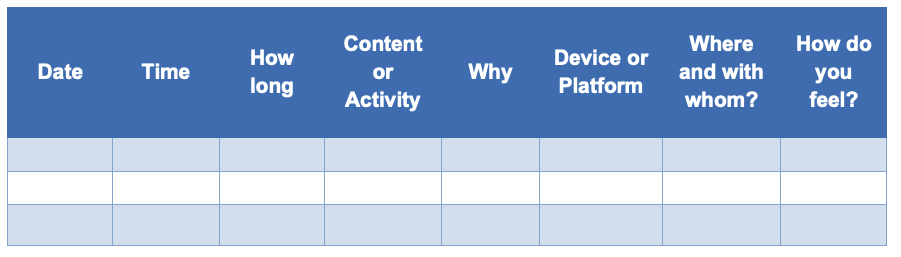
Log your media and technology use in a diary for a few days or a week. Research has repeatedly shown that self-monitoring increases awareness of our behavioral patterns and provides some insight into the circumstances and triggers around those behaviors 4. Self-monitoring is central to self-regulation, whether it’s diet, exercise, or media use. If we don’t accurately assess what we’re doing, we don’t know what behaviors make sense to change. Keeping a log is also important because people are not good at mentally estimating a day’s activities with accuracy. For example, people tend to underestimate calorie intake by 20-50% and overestimate exercise effort by 36-173% 5. Measures of media use are also difficult, but you’re trying to identify general trends, so what you’re doing and why is more important than how long you’re doing it.
In your media/tech diary (analog or digital), note when you use different devices or applications, your motivation, and the impact on your emotions. Make it easy, so you’ll do it. Use emojis or checkboxes. Here are some ideas of what to track. You can also download a PDF of my Mindful Media Journal here.
Step 3: Analysis
Once you have data, you can start to evaluate how your media and technology use is helping or hindering your goals by looking at use versus outcomes. Look for patterns. TikTok can be fun and relaxing, but it can also be guilt-inducing if it turns into a time suck. Checking your email sometimes is useful for your work. Other times, it might be a product of your anxiety. Checking your texts sometimes might be important to your relationships, but other times, it might be an unnecessary means of procrastination. Look for patterns. When does something go from positive to negative? What amount of engagement makes something positive or additive, and when does it detract?
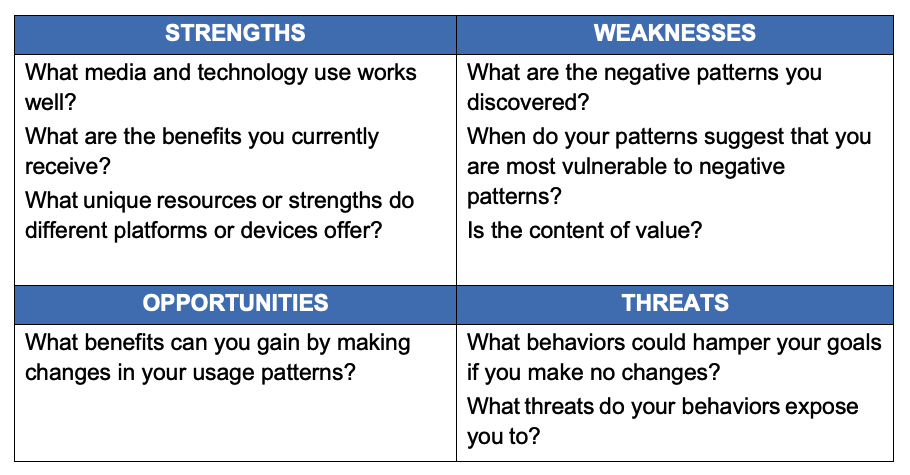
Now that you’ve gotten to know your media use patterns, you can do the SWOT analysis. Depending on your concerns, you can lump media together (everything with screens) or split things out, like social media, smartphones, or games. Add your own questions. Then, evaluate your behaviors based on each quadrant.
People use the best tools available to meet their goals, but two years of COVID-19 materially shifted media behaviors to offset social isolation. The sense of belonging from social connections is one of the primary drivers of human behavior and is essential to our mental and physical health. Media use was an adaptive behavior, becoming an automatic response to maintain belonging rather than an intentional action.
As we experienced during the pandemic, a virtual connection is better than no connection. However, humans are social animals, hardwired for face-to-face interaction. The simple act of shaking hands activates the brain’s reward center, builds trust, increases attentional focus, and enhances emotional contagion. Your life and media use may be perfectly balanced. But if not, the SWOT exercise is a way to take a look at your media habits and make sure pandemic media behaviors haven’t leaked over where they’re not helpful.
References
1. Ongweso Jr. E. Social Media Is Dead. Vicecom [Internet]. 2022. Available from: https://www.vice.com/en/article/pkgv79/social-media-is-dead.
2. Krishnamoorthy Y, Nagarajan R, Saya GK, Menon V. Prevalence of psychological morbidities among general population, healthcare workers and COVID-19 patients amidst the COVID-19 pandemic: A systematic review and meta-analysis. Psychiatry Res. 2020;293:113382.
3. Kiecolt-Glaser JK, Renna ME, Shrout MR, Madison AA. Stress Reactivity: What Pushes Us Higher, Faster, and Longer – and Why It Matters. Curr Dir Psychol Sci. 2020;29(5):492-8.
4. Burke LE, Wang J, Sevick MA. Self-monitoring in weight loss: a systematic review of the literature. J Am Diet Assoc. 2011;111(1):92-102.
5. Lee PH, Macfarlane DJ, Lam TH, Stewart SM. Validity of the international physical activity questionnaire short form (IPAQ-SF): A systematic review. International Journal of Behavioral Nutrition and Physical Activity. 2011;8(1):115.

 Dr. Pamela Rutledge is available to reporters for comments on the psychological and social impact of media and technology on individuals, society, organizations and brands.