
KEY POINTS:
- Social comparison is normal
- How we use the comparison determines how it affects us
- Looking for inspiration and ideas expands our world
- Focusing on things we can’t change undermines our self-worth
- With practice, we can control how we react
Everyone Compares Themselves to Others
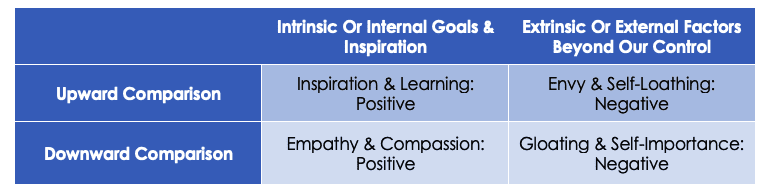
Social comparison has a bad reputation. One of the most common questions I get asked is, “What is the danger of comparing oneself to others on Instagram?” In an effort to reaffirm authentic beauty and self-esteem, we are in danger of making people feel bad for doing something natural and innate: social comparison. It’s not social comparison that’s the problem. It’s how we interpret and use comparisons that matter. Focusing on intrinsic goals—the things we can control—can inspire us. Concentrating on factors beyond our control is a shortcut to envy and self-loathing. It’s your choice.
Everyone compares themselves to others. Social comparison is hardwired—it is part of our biology. It is an essential skill to navigate social environments. Social comparison can be both positive and negative. It also goes in two directions: up and down. When we compare ourselves to someone we consider “better” somehow, we can compare the things we can’t control and feel bad about, or we can look at the things we can control and use them to learn, try new things, be motivated, and inspired.
Downward comparison is when we look down on someone or something and conclude that we’re better. While that sounds pretty good, it can also well or poorly. We can look at people going through hardship and feel empathy, compassion and even be inspired by their grit and resilience. Or we can focus on the externals and gloat because our car is more expensive, our kids are better looking our clothes are more stylish. This might give us some momentary self-satisfaction—we are only human after all—but the result is as bad for you as envy and self-loathing. Both focus on externals—it keeps you focused on the things you can’t control or change.
Looking for Inspiration Not Evaluation
If Maria sees other women working successfully from home might consider that an option when she had not before—thus allowing her to visualize herself working in that way. It doesn’t have anything to do with dissatisfaction with her life or her self-esteem. It might spark a realization that having the freedom to work from home is worth the insecurities that come with being self-employed, or it might encourage her to look for a job where she has the ability to work from home part of the time. Or she might decide that she values the interaction with colleagues and seeing someone working from home seems lonely and isolated. These are intrinsic, or internal, goals over which
In contrast, Maria might see the same image and focus on the extrinsic qualities or external factors such as the cost of her house or how she looks. The key is what we can actually control and what we can’t. If I am a tennis player and admire Serena Williams, I can look at her images and posts on Instagram. I can use these in two ways. I can feel sad because I will never be as tall, athletic, or as fierce as Serena. What can I do with this? I can beat myself up every time I think about tennis or play tennis because I will never be that good or that successful. I can tell myself I’m a loser, uncoordinated, and just not good enough. I can make myself feel really, really bad a lot of the time. And my tennis game will suffer.
On the other hand, I can look at Serena Williams and admire her strengths but take inspiration from how hard she works, the techniques she uses, how often she practices, or even the clothes she wears. I can use that to practice more, be reminded of the importance of hard work, and practice feeling fierce and determined when I put on my Serena Williams tennis outfit. If I do this, I can feel inspired, hopeful and my tennis game will improve.
No Image Impacts Us All The Same
We all make meaning from seeing images of others, but there is no guarantee that the meaning we make is the same. Where one woman sees an image and is thinking about the benefits of working from home, another might be admiring her hair quality. When we see a picture of another person, especially one that we admire, our brains take over and project all kinds of assumptions about what her life is like and how happy she is. It is all based on our internal desires, beliefs, and mental models. Instagram thrives by giving you visual narrative triggers—like those prompts in grade school where you had to make up a story based on a few pieces of information. The same information has the potential for many stories. Instagram, however, rewards images that trigger desire over critical thinking—which means our emotions and insecurities can drive the story unless we pay attention to our inner storyteller and change the plot.
Social comparison is only a problem if we let go of our inner compass and give too much power to external goals and our made-up assumptions. Seeing images can be one way of trying on situations and experimenting with who we want to be. This is like using selfies to try on different visual identities. Social comparison can be inspiring if we focus on the aspects of others within our control, like the kind of job we take or how hard we work, but not if we focus on the things we can’t change, like height or body shape. Comparing ourselves to others when it’s out of our control gives away our power. It depletes our energy, dampens our mood, and, sad but true fact, the worse we feel, the less creative, productive, and empathetic we are. That means we’re not much fun to be around, either.
If you can stay focused on images that inspire you to try new things, they can give you a plan of action for the future. We need to see the future to make changes. Images help us visualize new ways of being. If I want to work on my body, I will benefit from the experience if I focus on strength and health. If I model my success on an artificially imposed number on the scale or on a body I have no hope of ever looking like—especially if Photoshop was involved, I have just set myself up for failure. If we get stuck thinking about what we don’t have and let that drain our energy and darken our mood, we can beat ourselves up for days, weeks or—if we don’t break the habit–even years.
Overcoming Negative Social Comparison
How do you short-circuit the beast within? Pay attention to what’s going on in your head. When you are attracted to an image, ask yourself why. Some people win the genetic lottery. Most of us don’t. But I guarantee you that external beauty does not bring happiness if internal qualities of compassion and thoughtfulness aren’t part of the package.
- When you see an image – pay attention to how you feel.
- Label the feelings.
- What are you responding to?
- What are you assuming about the image? Advertising and Instagram are like dressing up for a party or watching a play. It’s not real. Nobody looks like that all the time (or sometimes ever).
- Listen to the voice in your head. What’s it telling you? Write it down.
- Most of the time, our internal voices are the least compassionate, most critical voices we’ll ever hear. Yet we believe things we hear a lot – even if we say it to ourselves. Even stuff like calling yourself “dummy” when you make a mistake adds up. You can imagine how damaging it is to tell yourself that you’re ugly.
- Would you say to your daughter or best friend what you just said to yourself?
- Rephrase the negative things you tell yourself into a more positive stance. Look for the positive you can take away. You can dye your hair blue. Don’t beat yourself up because you’ll never be tall.

 Dr. Pamela Rutledge is available to reporters for comments on the psychological and social impact of media and technology on individuals, society, organizations and brands.