 Story Power: The Psychology of Story
Humans have always been storytellers. Stories have been delivered across different media throughout recorded history, since the Cro-Magnon figured out that mineral pigments like iron oxide and black manganese could be applied to the sides of rocks and caves. Stories have chronicled life, communicated information and social norms to others, entertained and inspired. Storytelling is enabled or limited by the available technology.
The sophistication and capabilities of technology gives storytellers new challenges and opportunities far beyond what the cave painters and wandering minstrels could imagine. We now tell and consumer stories across platforms and in non-linear spaces. Transmedia storytelling describes the expansion of a story into a storyworld experience across multiple media platforms. Immersive storytelling uses virtual reality technology to enable the audience to step into a story and manipulate it visually. It is very exciting. But none of it is new. They are the technology-enabled mashup of ancient traditions and current communication models.
Media technologies have come a long way since illuminated manuscripts and Gutenberg’s press. Each new development enabled by technology expand capabilities, opening the door for increasingly sophisticated experiences. The orchestration of a story across multiple media platforms, such as we see in entertainment franchises, is a complex creative endeavor but one of many that challenged business models and rules of thumb. The use of multiple platforms created questions about ownership and authorship in the face of fan participation and, in the commercial world, challenged existing practices of production roles. New models drive change. The ability to orchestrate stories across platforms resulted in the Producers Guild of America added a transmedia producer designation in 2011. This was a first step in acknowledging the skillset of the producers who expand a storyline onto three or more platforms.
As technology becomes increasingly sophisticated, with AI, VR, and the jaw-dropping capabilities of CGI, consumer tools are becoming simultaneously more accessible and user-friendly. The boundaries are blurring not just across technologies but also across the people who are creating, using, producing, augmenting, distributing, hacking, mashing, and self-promoting. Consumer technologies have created YouTube Stars, Influencers, self-publishers and massive fanbases for traditional and emerging celebrities–all responding to the ability to tell a story.
The human brain is on a much slower evolutionary trajectory than technology. Our brains respond to content by looking for the story to make sense out of the experience. No matter what the technology, the meaning starts in the brain. The success of any story, transmedia or single platform, relies on the resonance, authenticity, and richness of the narrative created by the storyteller.
Stories are authentic human experiences. Stories leapfrog the technology and bring us to the core of experience, as any good storyteller knows.
There are several psychological reasons why stories are so powerful:
- Stories are a primal form of communication. They are timeless links to ancient traditions, legends, archetypes, myths, and symbols. As Carl Jung argued, humans share a collective unconscious, an understanding of patterns and meanings in experience. Stories tap into these universals, connecting us to a larger self and shared truths of humanity.
- The primary function of stories is social connection. Stories transcend generations, engaging us through emotions, and so we can share passions, sadness, hardships and joys, meaning and purpose. Stories provide a common ground that allows people to communicate, overcoming defenses and differences. Stories allow us to understand ourselves better and to see commonalities and have empathy for others.
- Stories are a Theory of Mind – narrative structure is how we think. Stories enable us to make meaning of life creating and drawing on schemas, scripts, cognitive maps, mental models, metaphors, and other stories. We use stories to explain how things work, why things happened, and how we decide. We use stories to persuade others and describe the future. Stories allow us to understand our place in the world, create and change our identities, and define and teach social values.
- Stories provide order. Humans seek certainty and narrative structure is familiar, predictable, and comforting. Within the context of the story arc, we can withstand intense emotions because we know that resolution follows the conflict. We can experience existential threats with a safety net.
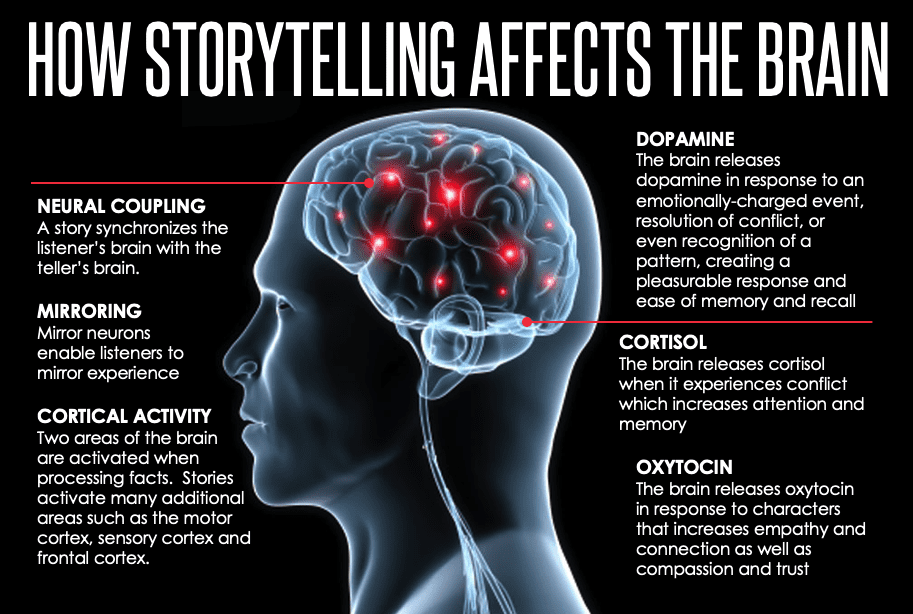
- Stories are pleasurable. The certainty of the story arc, identifying with a character, journeying to another world and achieving resolution releases a host of neurotransmitters that excite, reward and satisfy.
- Stories are how we are wired. Stores take place in the imagination. To the human brain, imagined experiences are processed the same as real experiences. Stories create genuine emotions, presence (the sense of being somewhere), and behavioral response through cortical activity, mirroring and neural coupling.
- Stories talk in images, engaging our right brain and triggering our imagination, allowing us to ‘see’ new worlds and new ways of being. Through the imagination, we become participants in a story. We can step into someone else’s shoes, see differently, and increase our empathy for others. Through imagination, we also reduce cognitive resistance and can tap into the creativity that is the foundation of innovation, self-discovery and change.
Social technologies have fundamentally changed what audiences want from a media experience. The ability to interact, share and be heard has established new expectations about authenticity, participation, and engagement. Special effects and funny Super Bowl ads are fine, but they are expensive one-offs if they do not touch the core of experience if they don’t deliver a meaningful story. When organizations, causes, brands or individuals identify and develop their core story, they are communicating their purpose and core values and displaying authentic meaning and purpose that others can believe, participate with, and share. This is the basis for cultural and social change within the organization and across society.
 Dr. Pamela Rutledge is available to reporters for comments on the psychological and social impact of media and technology on individuals, society, organizations and brands.
Comments are closed.