DR. PAM | MEDIA PSYCHOLOGIST
THE PSYCHOLOGY OF DIGITAL BEHAVIORS
  • Home
  • Blog
  • About
    • About Dr. Pamela Rutledge
    • Media Psychology
      • What Is A Media Psychologist?
      • 8 Reasons Why We Need Media Psychology
      • Careers in Media Psychology
      • Example Careers in Media Psychology
      • Media Psychology at Fielding Graduate University
      • Positive Media Psychology
    • MPRC
      • Media Psychology Research Center
    • Media Psychology Review
  • Consulting
    • Speaking & Consulting
    • Audience Engagement: Why Use Personas?
      • How to Build a Persona
    • Adapting to Change
    • Transmedia Storytelling
      • Storytelling Across Platforms
      • Transmedia Storytelling Starts with the Power of Story
      • Our Transmedia World
      • Transmedia Case Study: The Three Little Pigs
      • Transmedia Storytelling Workshop
  • Story Power
    • Brand Storytelling
    • Storytelling: Brands, Entertainment & Organizations
      • Storytelling for Organizations
      • Core Story: Case Study
  • In the News
    • Press Quotes & Interviews 2022-2025
    • 2021-2019
    • 2018-2016
    • 2016-2017
    • 2015-2013
    • 2012 & EARLIER
    • Video Interviews & Webinars
  • Resources
    • Mindful Media & Digital Literacy
      • Positive Media Psychology
      • Benefits of Video Games Part 1
      • Benefits of Video Games Part 2
      • Benefits of Video Games Part 3
      • Becoming Mindful: Exercises
      • Mindful Media Journal
    • Academic Materials
      • Media Psychology Syllabus 2021
      • Media Psychology Syllabus 2012
      • Media Psychology Syllabus 2015
    • Articles
      • Persuasion & Augmented Reality
      • Psychology of Transmedia Engagement
      • Theories of Attention
      • The Psychology of Color
      • Website Design: How to Use Psych Theory
      • Data Strategy: Listen to Your Consumers’ Stories
      • The Psychology of Story
  • Archives
  • Contact
DR. PAM | MEDIA PSYCHOLOGIST
  • Home
  • Blog
  • About
    • About Dr. Pamela Rutledge
    • Media Psychology
      • What Is A Media Psychologist?
      • 8 Reasons Why We Need Media Psychology
      • Careers in Media Psychology
      • Example Careers in Media Psychology
      • Media Psychology at Fielding Graduate University
      • Positive Media Psychology
    • MPRC
      • Media Psychology Research Center
    • Media Psychology Review
  • Consulting
    • Speaking & Consulting
    • Audience Engagement: Why Use Personas?
      • How to Build a Persona
    • Adapting to Change
    • Transmedia Storytelling
      • Storytelling Across Platforms
      • Transmedia Storytelling Starts with the Power of Story
      • Our Transmedia World
      • Transmedia Case Study: The Three Little Pigs
      • Transmedia Storytelling Workshop
  • Story Power
    • Brand Storytelling
    • Storytelling: Brands, Entertainment & Organizations
      • Storytelling for Organizations
      • Core Story: Case Study
  • In the News
    • Press Quotes & Interviews 2022-2025
    • 2021-2019
    • 2018-2016
    • 2016-2017
    • 2015-2013
    • 2012 & EARLIER
    • Video Interviews & Webinars
  • Resources
    • Mindful Media & Digital Literacy
      • Positive Media Psychology
      • Benefits of Video Games Part 1
      • Benefits of Video Games Part 2
      • Benefits of Video Games Part 3
      • Becoming Mindful: Exercises
      • Mindful Media Journal
    • Academic Materials
      • Media Psychology Syllabus 2021
      • Media Psychology Syllabus 2012
      • Media Psychology Syllabus 2015
    • Articles
      • Persuasion & Augmented Reality
      • Psychology of Transmedia Engagement
      • Theories of Attention
      • The Psychology of Color
      • Website Design: How to Use Psych Theory
      • Data Strategy: Listen to Your Consumers’ Stories
      • The Psychology of Story
  • Archives
  • Contact
Jun 27
Kids and Chatbots Parent Guide

Chatbots and Kids: What Parents Need to Know Now

  • June 27, 2025
  • Pamela Rutledge
  • No Comments

Here's how to talk to your child about AI, starting in preschool. A free downloadable Parent Guide with tips and conversation starters is included.

Chatbots are computer programs that use AI to tell stories, offer advice, provide information, or chat with you using text, voice, or video. Popular tools include ChatGPT, Snap's My AI, Replika, and Google's new chatbot for kids under 13 called Gemini. These tools are increasingly being integrated into apps, games, and websites that kids use every day. A harbinger of things to come, Mattel and OpenAI announced a partnership, suggesting that soon Barbie will have a lot to say. I wrote about why chatbots are so appealing to kids in a recent post Kids and Chatbots: When AI Feels Like A New Best Friend and Diana Graber and I tackled it in our recent Cyberwise Chat. The link to the video/podcast is here and I am sharing the downloadable Parent Guide that I made to accompany our chat. See below.

This is just the beginning of the chatbot story, as the availability and sophistication of generative AI tools increase constantly. We waited too long to prepare our kids for social media. Let’s not make the same mistake again. Chatbots can influence how children learn, socialize, and view the world. While some are educational and support creativity, others can give misleading or just plain wrong information, but their human-like communication patterns blur the line between human and machine, and their responsiveness and the sheer volume of information make AI tools seem like authorities and trusted friends.

We all have the tendency to anthropomorphize--attribute human traits, emotions, and intentions to non-human entities. We do it to cars, toasters, and computers—and they don’t engage us in conversation. This is a natural response, driven by our reliance on social cognition and pattern-seeking as part of our survival instinct.

For kids, however, the ability to tell reality from fantasy develops sometime early to middle childhood. This tendency toward magical thinking is why reinforcing chatbots as tools and not people is critical from the start. Even once kids reach middle childhood or beyond, they are not immune to developing an emotional attachment to chatbots. Emotional regulation and critical thinking continue to develop. The prefrontal cortex is not fully mature until the mid-20s. When a chatbot responds as if it were a friend, the effect of being 'seen and heard' is powerful, making kids vulnerable to developing emotional attachments.

Understanding how these bots work—and having open conversations about their benefits and risks—can help kids use them safely and responsibly. The downloadable Parent Guide summarizes some of the main facts into tables and provides ideas for getting the conversation started with your kids, no matter what their age.

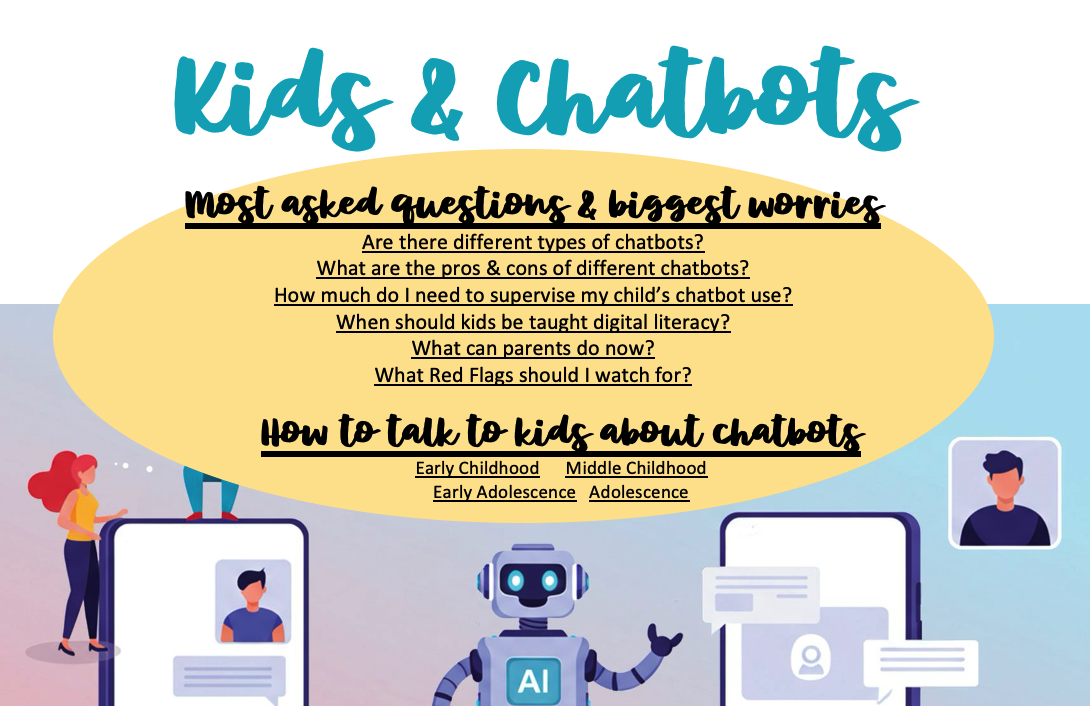
Handout Contents

Parents’ most asked questions and worries about chatbots and kids

  • Are there different types of chatbots?
  • What are the pros & cons of different chatbots?
  • How much do I need to supervise my child's chatbot use?
  • When should kids be taught digital literacy?
  • What can parents do now?
  • What Red Flags should I watch for?

How to talk to kids about chatbots by developmental stage

  • Early childhood
  • Middle childhood
  • Early adolescence
  • Adolescence

Bottom Line: Talk Early and Often

AI interactivity—whether chatbots or behind the scenes—is here to stay. The goal isn't to shut it out but to help kids recognize it and make sense of it. Chatbots may talk like friends, but they aren't human. They don't replace the need for real connection. The most powerful thing a parent can do is have open conversations that build a foundation of trust so that the parent becomes the go-to source for questions and issues. With age-appropriate boundaries, respect, and curiosity, families can turn chatbot use into an opportunity for learning and growth.

The downloadable Parent Guide that summarizes some of the main ideas into tables and has ideas for getting the conversation started with your kids no matter what their age.

See https://www.cyberwise.org/chatbots to watch the video.

  • Facebook
  • Twitter
  • Reddit
  • LinkedIn
  • E-Mail

About The Author

Pamela Rutledge, PhD, MBA is the Director of the Media Psychology Research Center. A consultant, author, speaker, and professor, she consults on a variety of media projects developing audience engagement and brand storytelling strategies.

Leave a reply

Your email address will not be published. Required fields are marked *

This site uses Akismet to reduce spam. Learn how your comment data is processed.

FOR THE PRESS

Dr. Pam Rutledge, media psychologistDr. Pamela Rutledge is available to reporters for comments on the psychological and social impact of media and technology on individuals, society, organizations and brands.  pamelarutledge@gmail.com

SEARCH THE SITE

RECENT POSTS

  • Do You Want Your Kids Arguing Like a Politician?
  • U.S. Politics Look Like a Bad Marriage
  • We’re Being Played: Propaganda, Memes and War
  • The Legacy of Daytime Talk Shows Lives in Your Feed
  • Oprah's High Road: Diverging Paths in Daytime Talk Shows

MEDIA PSYCHOLOGY RESEARCH

The Media Psychology Research Center (MPRC) is an independent research organization directed by Dr. Pam Rutledge.  Read about MPRC at www.mprcenter.org.

CONSULTING PROJECTS

Dr. Rutledge consults on a variety of media projects using psychology to translate data into human behavior for powerful results.

  • Parenting in a Digital World webinar series
  • Persona Development for audience segmentation
  • Fan and Audience Engagement: Identifying audience narratives to satisfy needs
  • Brand Storytelling: Supercharging brand meaning

RECENT POSTS

  • Do You Want Your Kids Arguing Like a Politician?
  • U.S. Politics Look Like a Bad Marriage
  • We’re Being Played: Propaganda, Memes and War
  • The Legacy of Daytime Talk Shows Lives in Your Feed
  • Oprah's High Road: Diverging Paths in Daytime Talk Shows

SEARCH

Content copyright Pamela Rutledge 2026.