
Takeaways:
- Young Influencers don’t have any relevant experience understanding influence or managing fame
- Gen Z and Millennials relate more to Influencers than to traditional celebrities
- Parasocial attachment increases an Influencer’s persuasiveness because they feel like a friend
- This is not about parenting, it’s about digital literacy so kids are less vulnerable to social influence

The popular social media streamer Kai Cenat and fellow streamer Fanum announced to their followers that they would give away electronics, including PlayStation 5 consoles, on Friday, August 4, at 4 pm. Thousands of fans showed up to get the prizes, filling the street, stopping traffic, and becoming increasingly unruly. Police were cad in to manage the crowd, resulting in several arrests and injuries as the crowd, mostly teens, threw rocks and bottles, stormed a construction site, and climbed on cars. In other words, they behaved like unruly teens. Cenat was charged with inciting a riot and unlawful assembly. His PR firm AMP issued a statement of regret, saying they did not condone violence.
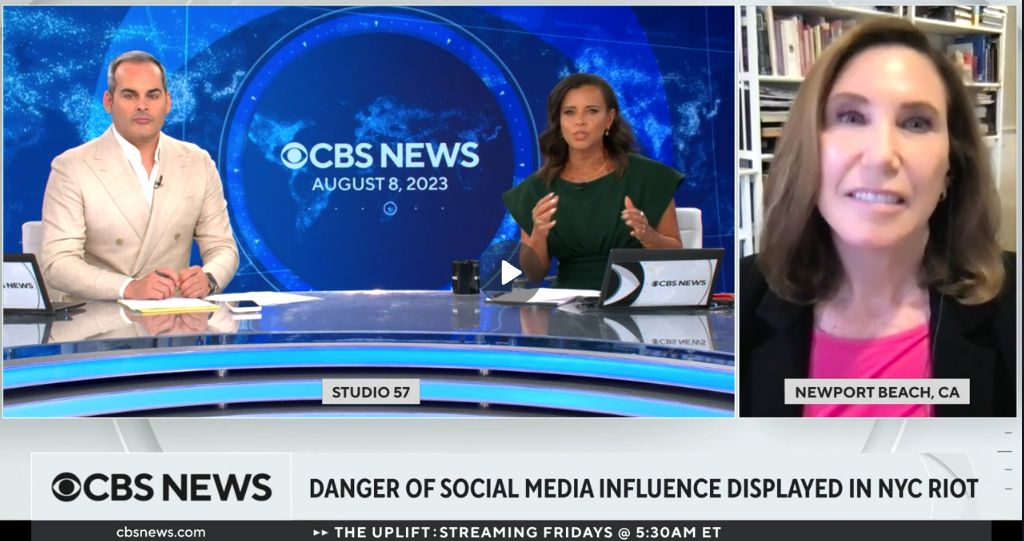
For many people, the initial response is, “What did they think would happen when an Influencer with millions of teenage followers announced a giveaway of a highly coveted gaming console in NYC?” But my guess is that neither Cenat nor AMP had a clue—although AMP probably should have anticipated some of it. It was, after all, a live meetup with a popular Influencer at rush hour. However, Cenat was perhaps only looking forward to seeing the evidence of his success and feeling the love. He only started social media in 2021, and his notoriety and influence have skyrocketed in a surprisingly short amount of time, earning him millions and providing him with an unending supply of dopamine hits from his enthusiastic young followers.
Influencers Go from Virtual to Real
Influencers are no longer just online. It’s time for Influencers and agencies alike to take note: this isn’t just a cottage industry or a hobby. It’s big business, and the combination of platforms means that an Influencer’s reach can be significant. It’s time for the Influencers and their agents to understand the responsibilities that come with fame.
Celebrities have always been influential. Media attention and financial success validate their relative importance, elevation them into role models. In the last 20 years, the role of Influencers has developed into a multi-billion-dollar industry. This is no cottage industry of mommy bloggers. Brands invest seriously in Influencers—particularly those who resonate with Gen Z– preferring micro-influencers to macro-influencers and celebrities.
Brands are putting money into Influencer marketing for good reason. As the buying power of Gen Z and Millennials grows, companies are scrambling to be relevant, trying to reach young audiences through social media. Traditional celebrity endorsements don’t always cut it. Gen Z and Millennials relate more to Influencers than to traditional celebrities and feel they are more authentic and trustworthy. Over 60% of TikTok users are in the trend-setting Gen Z (Wallaroomedia, 2023, April 7). Not surprising when you consider that young people developmentally crave social connection, and the pandemic accelerated the shift to conducting life online. The intimacy of social media can make it a viable and even satisfying means of connecting when other avenues are closed.
Social Media Replicates Interpersonal Intimacy
Several aspects of social media make it more compelling than legacy media formats. Unlike traditional programming, Influencers must publish content constantly to maintain the views they need to keep their income flowing. New content means a constant source of new stimulus for the viewer and an increasing sense of familiarity with the Influencer—especially when they share personal details. Influencers also take advantage of social media’s format—looking straight into the camera, making virtual eye contact, responding to comments, and, when livestreaming, interacting with viewers in real-time. Add to this the fact that our brains often respond to virtual situations as if they were real. So, when an Influencer looks into the camera and smiles, the viewer’s brain feels like they’ve made genuine contact (Nummenmaa et al., 2012; Sherman et al., 2018).
The frequency, interactivity, and identification can create an emotional attachment called a parasocial relationship. The follower begins to feel as if the Influencer is a real friend; they feel like they know the Influencer personally and often feel like the Influencer is aware of them, too. The follower’s sense of attachment makes an Influencer very powerful because people are much more likely to take the advice of or follow the behavior of a friend. When this happens, Influencers are essentially word-of-mouth advertising, whether or not their sponsorships are transparent (Sokolova & Kefi, 2020).
Teens: High Social Motivations and Low Emotion-Regulation
Tweens, teens, and young adults are socially driven, as learning to navigate the social world is a normal part of age-appropriate human development. However, the world Influencers present to their followers isn’t the normal social world. Yet Influencers are role models because they seem so real and relatable. Like most things, the impact can be positive or negative. Influencers can promote healthy attitudes, support identity exploration, reduce prejudice, and enhance feelings of connection. But Influencers can so adversely affect mental health and behavior through social comparison, increased materialism, perpetuating stereotypes, and normalizing unhealthy or antisocial behaviors (Hoffner & Bond, 2022)
Lessons from Kai Cenat’s Live Meetup Giveaway
So where does that mean when thinking about the crowd of Cenat followers who showed up in Union Square? Here are some things to note about Cenat’s live meetup and giveaway:
- While Influencer meetups have occurred before, none have attracted the size of a crowd that came to see Cenat. Therefore, it would be hard for anyone to anticipate this outcome, especially someone as inexperienced in pubic events as Cenat.
- I suspect that Cenat hoped to make a really big but positive impact.
- Influencers are, by nature, eager for attention. It is both psychologically rewarding, as fan responses trigger the neural reward center, and financially rewarding. Thus, we would expect Influencers would be eager to hold events to connect with fans.
- Cenat’s million-plus followers from Twitch, YouTube, and TikTok tend to be young. Young people’s brains are still developing and often do not have the full ability to assess risk, anticipate outcomes, or manage emotional responses. Thus, it’s not surprising to see young people excited into a near frenzy by free giveaways of something they emotionally value (PlayStations), even if the chances of winning something are small
- The chance to meet an admired Influencer is very compelling, especially if there is a parasocial attachment. There is equally great appeal among up-and-coming Influencers to create a dedicated following. VidCon is organized entirely around arranging Influencer-fan connections and providing content creators with information about growing and sustaining their audiences.
- Most Influencers are young and get famous very quickly. They are not trained in managing the business they have become and, given the personality types likely to seek out fame, are unlikely to exercise restraint in the goal of building an audience. They have to reach a certain number of followers to generate the income to hire PR teams and managers to negotiate sponsorships. Still, they often do not have the training or maturity to manage the situation or the people they hire. We also know that instant fame or youth+fame can be psychologically challenging, even with the financial and privilege perks (Baker & Balanzategui, 2023; O’Connor, 2011). Expecting a young Influencer to anticipate something they’ve never seen is unreasonable, even if it seems obvious to others.
- Young people are volatile and not forward-thinking. It is not surprising that an unplanned crowd of teens turns unruly, even ugly. Aside from the difficulties many teens have with emotion regulation, young people distrust authority. Additional challenges arise when race becomes a factor. Attempt to manage a crowd are seen as thwarting the young people’s goals and will cause an often inappropriately violent reaction. The volatility and lack of control are amplified in groups.
- The response by Mayor Adams that “youth crime is a parenting issue,” is a political response, not a realistic one. The actions of the crowd are not simply about parenting, except in so far as parents need to make sure their kids (and themselves) are digitally literate. Understanding the psychological dynamics of influence can help keep all of us from being reactive and manipulated on social media and better able to engage in online activities more safely and with more self-control. This is something that grows over time.
References
Baker, D., & Balanzategui, J. (2023). Heritage child stars on Disney+: the liquidities of child stardom in the SVOD era. Celebrity Studies, 14(2), 186-199. https://doi.org/10.1080/19392397.2022.2109307
Hoffner, C. A., & Bond, B. J. (2022). Parasocial relationships, social media, & well-being. Current Opinion in Psychology, 101306.
Nummenmaa, L., Glerean, E., Viinikainen, M., Jääskeläinen, I. P., Hari, R., & Sams, M. (2012). Emotions promote social interaction by synchronizing brain activity across individuals. Proceedings of the National Academy of Sciences of the United States of America, 109(24), 9599-9604. https://doi.org/10.1073/pnas.1206095109
O’Connor, J. (2011). From Jackie Coogan to Michael Jackson: What child stars can tell us about ideologies of childhood. Journal of Children and Media, 5(3), 284-297. https://doi.org/10.1080/17482798.2011.584378
Sherman, L. E., Hernandez, L. M., Greenfield, P. M., & Dapretto, M. (2018). What the brain ‘Likes’: neural correlates of providing feedback on social media. Social Cognitive and Affective Neuroscience, 13(7), 699-707. https://doi.org/10.1093/scan/nsy051
Sokolova, K., & Kefi, H. (2020). Instagram and YouTube bloggers promote it, why should I buy? How credibility and parasocial interaction influence purchase intentions. Journal of Retailing and Consumer Services, 53, 101742. https://doi.org/https://doi.org/10.1016/j.jretconser.2019.01.011
Wallaroomedia. (2023, April 7). TikTok Statistics – Updated Aug 2023. https://wallaroomedia.com/blog/social-media/tiktok-statistics/#:~:text=This%20data%20comes%20straight%20from,Gen%20Zers%20are%20trendsetters

 Dr. Pamela Rutledge is available to reporters for comments on the psychological and social impact of media and technology on individuals, society, organizations and brands.