Get smart about your digital habits. Try these 8 small hacks to change automatic behaviors to intentional ones and improve real-life connections and well-being.
Key Points:
- Reliance on digital communication during the pandemic was a lifeline then, but some of those habits may contribute to loneliness and disconnection now.
- Social skills were neglected during the pandemic, making us out-of-practice and potentially anxious about in-person interactions.
- Social media’s dopamine rewards create the illusion of connection, but short-term feel-goods don’t replace the long-term satisfaction of deep human bonds.
- Keeping a media journal can track habits and identify unhelpful digital behaviors you can hack to improve real-life relationships.
Last week, I joined Simone Heng (2023) to discuss the loneliness epidemic with the Harvard Undergraduate UNICEF Club. Loneliness is a complex topic because it is a subjective emotional state that comes from lacking meaningful social connections. While not the same as being physically alone, prolonged social isolation is a major contributor to loneliness. Social connection is central to our physical and mental well-being. Not surprisingly, the drive to connect is a powerful motivator, and we humans continuously look for ways to make meaningful connections. Unfortunately, the design of modern society works against us (Cacioppo & Cacioppo, 2018). We have social isolation fueled by urbanization, changing family structures, loss of trust in institutions and traditions, economic hardships, and increased use of digital communication. There is no single “cure-all” lever to pull, and systemic shifts like urbanization aren’t something we’re going to change overnight. However, there were many questions about the impact of widespread digital communications use and what to do about it.
Short answer: Examining and adjusting digital behavior can go a long way toward improving our sense of connection.
Reviewing digital communication habits is especially important for young people as they are particularly vulnerable to loneliness. Adolescence and young adulthood are critical developmental periods for identity formation and social exploration. During this period, young people rely heavily on peer validation and social engagement to develop social skills, find their place, and construct their self-concept. Young people are also highly sensitive to the lack of social opportunities and can feel overwhelmed by rejection, isolation, and exclusion (von Soest et al., 2020).Subscribed
The Impact of COVID-19 on Social Development
During the pandemic, digital communication was a crucial lifeline for young people, allowing them to maintain friendships and social engagement during lockdowns. However, the pandemic disrupted normal social experiences and massively impacting daily routines. According to Pew Research, nearly three out of four Americans say the pandemic took a toll on them, and more than 1 million Americans died from the virus (Tyson et al., 2025).
For young people, this meant missing crucial years of in-person social practice. The pandemic used up approximately 10% of an average teen’s life. This is time they would have spent gaining real-world practice and developing social skills in group settings, like hanging out at the mall, going to school, and dating.
How a Behavior Becomes a Habit
While social media is not the sole cause of loneliness, it is part of the environment that shapes social interactions and constructs cultural norms. During the pandemic, virtual communications, whether text, social media, or Facetime, were the only way to approximate normal social activities. Virtual interactions helped reduce feelings of loneliness, reducing levels of anxiety and depression (Loades et al., 2020). Digital communication also helped maintain emotional support networks crucial for coping with pandemic-related stress (Orben et al., 2020). It lasted long enough, however, to create new habits, normalizing the primacy of digital connections in socializing, dating, and building relationships.
Habits are formed through repeated actions that create neural pathways in the brain, making behaviors automatic over time. All behaviors, whether conscious or unconscious, serve a function, but what is adaptive under one set of circumstances may not be in another. During COVID-19 lockdowns, relying on digital technology was adaptive. It takes an average of 66 days for a new behavior to become automatic, but the range is between 18 to 254 days depending on the complexity of the behavior. Two years (730 days) of the pandemic is plenty long enough to turn adaptive behaviors into automatic habits. Now, we all, but especially young people, face the challenge of identifying our COVID-adaptive habits and asking: Which of our current habits are effective in supporting relationships and building connections today, and which are maladaptive, contributing to feelings of loneliness and disconnection?
Relearning Connection Skills
Many heads were nodding in recognition when we talked about the potential challenges of changing from virtual to in-person connection. Learned behaviors are hard to kick. Social anxiety can arise when we reconcile COVID-19 anxieties with the current environment, such as navigating campuses and classrooms, commuting to the office, standing in line at the grocery store, hugging acquaintances, or sitting beside a stranger in a movie theater. Some adapt easily. For many, especially we introverts, these experiences require conscious relearning, so we don’t automatically revert to our internalized COVID-19 levels of caution.
Reinstating a balance between in-person and virtual connection habits is harder when social media doles out rewards. Likes and comments trigger the feel-good dopamine shots that make strangers’ responses seem like genuine social connections but do little to create a sense of belonging. Habitual scrolling and algorithm-driven content consumption can suppress discomfort. But they can also reinforce feelings of exclusion, inadequacy, and disconnection, making us more vulnerable to negative social comparison. However, unintentionally, we risk amplifying feelings of loneliness by not putting our technology habits under a microscope and figuring out what works and what doesn’t.
How Algorithms Contribute to Loneliness
Social media algorithms are at work behind the scenes, invisibly influencing our digital environments by masterfully curating content based on our online behaviors. These personalized feeds pull us in but they also skew reality, creating echo chambers that repeatedly expose us to content that aligns with our beliefs, preferences, and behaviors (Cinelli et al., 2021). Our identity and sense of self are constructed from the stories we hear and those we tell, drawn from our experiences and social environment (McAdams, 2001). Algorithms create increasingly targeted experiences that narrow perspectives and alter perceived norms while filtering out opposing viewpoints. This can be psychologically comforting—reaffirming our worldview fosters a sense of safety and belonging–but it also constrains self-perception and discourages social exploration because deviation creates cognitive dissonance and fear of rejection, further reinforcing a rigid self-narrative.
An inflexible sense of self fosters loneliness by encouraging an “us vs. them” mentality. This type of othering dehumanizes out-group members, perpetrating stereotypes and rationalizing abuse. It also hurts us by limiting “acceptable” social connections, decreasing our empathy for others, distorting expectations for relationships, and escalating our distrust of others, increasing the likelihood of conflict. Echo chambers that repeatedly affirm group identity can lead to self-imposed isolation or withdrawal into the insular network, reinforcing feelings of loneliness.
From Automaticity to Intention
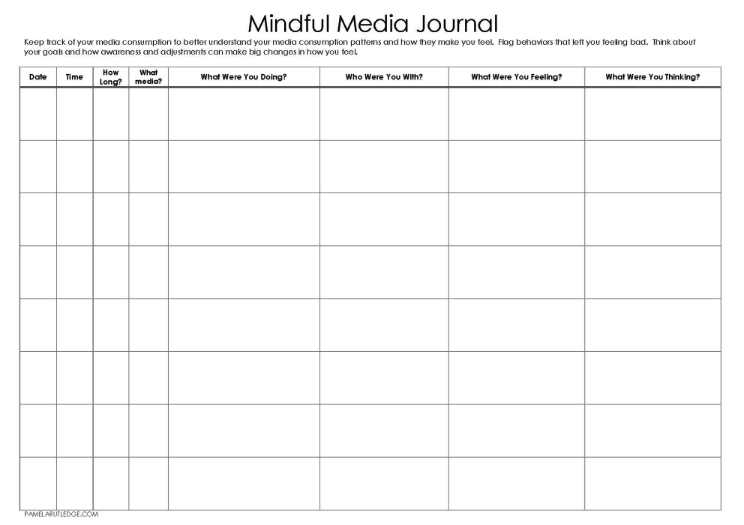
Recognizing how algorithms manipulate beliefs is an essential step in digital literacy. However, a more significant issue is looking in the mirror and facing our own behaviors. Are we willing to do the work to have a healthy relationship with technology? If so, we must bite the bullet and do the work. Keeping a media journal for a week is one way to track your technology use patterns to get a handle on what you use, when and why, and how it makes you feel. You have to know what you’re doing to make a change. Here’s a PDF sample of the journal page below. Add your own columns to stay focused on your goals. Feel free to streamline if that means you’ll do it.
Support People Navigating Social Discomfort
The next step is compassion. Change is hard, especially when altering digital communication habits activates social anxiety and a lack of confidence in social skills. Feeling hesitant or fearing judgment—common concerns during adolescence—can increase socially avoidant behaviors, like choosing texting over talking in person, reinforcing social withdrawal.
While young people have become more open about mental health, admitting to loneliness, which implies a lack of friends, remains stigmatized. Addressing the loneliness epidemic means normalizing the idea that seeking social support is a strength. Helping young people recognize that they lost critical years to practice social skills can help remove feelings of inadequacy and encourage social confidence.
Move Toward Intention
Digital friendships have value, but in-person interactions provide deeper emotional fulfillment. Rather than demonizing social media, we should empower young people to take charge of their media use by identifying goals and developing management skills. Digital literacy starts by evaluating technology use and understanding how it is designed to attract and keep our attention. Banning platforms or imposing strict limits fosters guilt and shame rather than critical thinking and digital safety. Encouraging intentional use fosters awareness and control.
Try These Small Hacks to Encourage More Meaningful Connection
Big changes come from a series of tiny habits (Fogg, 2020). Keeping a media journal can highlight the easiest places to upend habits with small hacks. Behavior change takes practice and is often uncomfortable, so be patient and compassionate.
- Engage in serendipitous connections. Take Simone Heng’s advice to take your earphones off and put your phone away when standing in line for coffee at Starbucks (or at the grocery store) to enjoy serendipitous connections with the others in line or behind the counter. There’s psychology behind this: Talking with people creates a shared experience—even if you’ll never see them again. Shared experiences increase enjoyment, but being in something together also lightens burdens (like, will we EVER get through this line?)
- Practice mindfulness. Don’t automatically take your phone into the bathroom, mailbox, or other places where you’re filling dead space. Pay attention. You’ll be surprised how often you pull out your phone without thinking about it.
- Go shared, not solo. Turn screen time into social time. Turn solo video gaming into a game night or invite friends to a watch party rather than streaming alone.
- Establish device-free zones. Encourage conversation by making meals a phone-free zone. Have a “phone bedtime” when it goes off for the night.
- Plan ahead. Make a list of non-digital activities to turn to when you’re bored before you reach for your phone.
- Prioritize real relationships. Let downtime trigger a call to a friend instead of mindless scrolling.
- Be Real. Talk with others, especially your kids, about the difficulty of changing habits and acknowledge the potential discomfort of being vulnerable in person.
- Dampen Temptation. Make your phone less appealing. Switch to grayscale mode, organize apps into folders, and disable non-essential notifications.
Digital spaces are not the only contributors to loneliness, but they are something we can assess and manage. Invest in yourself by monitoring your media habits for a few days to see how to use technology more intentionally. TikTok and Instagram may not charge users money, but you pay with a much more valuable currency–your attention. Don’t give away your power by letting algorithms, likes, and other digital social cues construct your world. Take charge of your technology use in ways that enhance relationships. In doing so, you can replace feelings of disconnection with increased well-being.Subscribed
References
Cacioppo, J. T., & Cacioppo, S. (2018). The growing problem of loneliness. The Lancet (British edition), 391(10119), 426-426. https://doi.org/10.1016/S0140-6736(18)30142-9
Cinelli, M., De Francisci Morales, G., Galeazzi, A., Quattrociocchi, W., & Starnini, M. (2021). The echo chamber effect on social media. Proceedings of the National Academy of Sciences, 118(9), e2023301118. https://doi.org/doi:10.1073/pnas.2023301118
Fogg, B. J. (2020). Tiny habits: The small changes that change everything. Harvest.
Gotlib, I. H., Miller, J. G., Borchers, L. R., Coury, S. M., Costello, L. A., Garcia, J. M., & Ho, T. C. (2023). Effects of the COVID-19 pandemic on mental health and brain maturation in adolescents: Implications for analyzing longitudinal data. Biological Psychiatry: Global Open Science, 3(4), 912-918. https://doi.org/10.1016/j.bpsgos.2022.11.002
Heng, S. (2023). Let’s talk about loneliness: The search for connection in a lonely world. Hay House.
Loades, M. E., Chatburn, E., Higson-Sweeney, N., Reynolds, S., Shafran, R., Brigden, A., Linney, C., McManus, M. N., Borwick, C., & Crawley, E. (2020). Rapid systematic review: The impact of social isolation and loneliness on the mental health of children and adolescents in the cCOVID-19f covid-19. Journal of the American Academy of Child & Adolescent Psychiatry, 59(11), 1218-1239.e1213. https://doi.org/10.1016/j.jaac.2020.05.009
McAdams, D. P. (2001). The psychology of life stories. Review of General Psychology, 5(2), 100-122. https://doi.org/10.1037/1089-2680.5.2.100
Orben, A., Tomova, L., & Blakemore, S.-J. (2020). The effects of social deprivation on adolescent development and mental health. The Lancet Child & Adolescent Health, 4(8), 634-640. https://doi.org/10.1016/S2352-4642(20)30186-3
Tyson, A., Lipka, M., & Deane, C. (2025). 5 years later: America looks back at the impact of covid-19. Pew Research Center.
von Soest, T., Luhmann, M., & Gerstorf, D. (2020). The development of loneliness through adolescence and young adulthood: Its nature, correlates, and midlife outcomes. Developmental Psychology, 56(10), 1919-1934. https://doi.org/10.1037/dev0001102

 Dr. Pamela Rutledge is available to reporters for comments on the psychological and social impact of media and technology on individuals, society, organizations and brands.