DR. PAM | MEDIA PSYCHOLOGIST
THE PSYCHOLOGY OF DIGITAL BEHAVIORS
  • Home
  • Blog
  • About
    • About Dr. Pamela Rutledge
    • Media Psychology
      • What Is A Media Psychologist?
      • 8 Reasons Why We Need Media Psychology
      • Careers in Media Psychology
      • Example Careers in Media Psychology
      • Media Psychology at Fielding Graduate University
      • Positive Media Psychology
    • MPRC
      • Media Psychology Research Center
    • Media Psychology Review
  • Consulting
    • Speaking & Consulting
    • Audience Engagement: Why Use Personas?
      • How to Build a Persona
    • Adapting to Change
    • Transmedia Storytelling
      • Storytelling Across Platforms
      • Transmedia Storytelling Starts with the Power of Story
      • Our Transmedia World
      • Transmedia Case Study: The Three Little Pigs
      • Transmedia Storytelling Workshop
  • Story Power
    • Brand Storytelling
    • Storytelling: Brands, Entertainment & Organizations
      • Storytelling for Organizations
      • Core Story: Case Study
  • In the News
    • Press Quotes & Interviews 2022-2025
    • 2021-2019
    • 2018-2016
    • 2016-2017
    • 2015-2013
    • 2012 & EARLIER
    • Video Interviews & Webinars
  • Resources
    • Mindful Media & Digital Literacy
      • Positive Media Psychology
      • Benefits of Video Games Part 1
      • Benefits of Video Games Part 2
      • Benefits of Video Games Part 3
      • Becoming Mindful: Exercises
      • Mindful Media Journal
    • Academic Materials
      • Media Psychology Syllabus 2021
      • Media Psychology Syllabus 2012
      • Media Psychology Syllabus 2015
    • Articles
      • Persuasion & Augmented Reality
      • Psychology of Transmedia Engagement
      • Theories of Attention
      • The Psychology of Color
      • Website Design: How to Use Psych Theory
      • Data Strategy: Listen to Your Consumers’ Stories
      • The Psychology of Story
  • Archives
  • Contact
DR. PAM | MEDIA PSYCHOLOGIST
  • Home
  • Blog
  • About
    • About Dr. Pamela Rutledge
    • Media Psychology
      • What Is A Media Psychologist?
      • 8 Reasons Why We Need Media Psychology
      • Careers in Media Psychology
      • Example Careers in Media Psychology
      • Media Psychology at Fielding Graduate University
      • Positive Media Psychology
    • MPRC
      • Media Psychology Research Center
    • Media Psychology Review
  • Consulting
    • Speaking & Consulting
    • Audience Engagement: Why Use Personas?
      • How to Build a Persona
    • Adapting to Change
    • Transmedia Storytelling
      • Storytelling Across Platforms
      • Transmedia Storytelling Starts with the Power of Story
      • Our Transmedia World
      • Transmedia Case Study: The Three Little Pigs
      • Transmedia Storytelling Workshop
  • Story Power
    • Brand Storytelling
    • Storytelling: Brands, Entertainment & Organizations
      • Storytelling for Organizations
      • Core Story: Case Study
  • In the News
    • Press Quotes & Interviews 2022-2025
    • 2021-2019
    • 2018-2016
    • 2016-2017
    • 2015-2013
    • 2012 & EARLIER
    • Video Interviews & Webinars
  • Resources
    • Mindful Media & Digital Literacy
      • Positive Media Psychology
      • Benefits of Video Games Part 1
      • Benefits of Video Games Part 2
      • Benefits of Video Games Part 3
      • Becoming Mindful: Exercises
      • Mindful Media Journal
    • Academic Materials
      • Media Psychology Syllabus 2021
      • Media Psychology Syllabus 2012
      • Media Psychology Syllabus 2015
    • Articles
      • Persuasion & Augmented Reality
      • Psychology of Transmedia Engagement
      • Theories of Attention
      • The Psychology of Color
      • Website Design: How to Use Psych Theory
      • Data Strategy: Listen to Your Consumers’ Stories
      • The Psychology of Story
  • Archives
  • Contact
Mar 09
Stories take us on a journey

Stories are VRBO for the Brain: A Journey to Another World

  • March 9, 2020
  • Pamela Rutledge
  • No Comments

Continued from Screen size Changes the Meaning and Impact of Content.

There is something particularly alluring about stories that take place outside of our known world.  Historical, fantasy and sci-fi stories take the consumer on a delicate balance of fact and fiction to create something that feels right.  The illusion of reality wrapped in fiction triggers comparisons between “then” and now as we project ourselves into the story and psychologically try out different roles.  Outlander, for example, is a historical drama with a twist of time-travel.  In the narrative, one of the protagonists, Clare, is doing exactly what the audience is doing—going back in time.  It is, as my daughter would say, very meta.

We may be familiar with a particular history, time or have fantasies about future worlds, but entertainment fills out the social and human motives and the characters’ emotions.  Similarly, sci-fi and fantasy explore a vast array of setting as petri dishes for human behavior full of alluring images and aesthetics.  The similarities allow us to emotionally experience the differences.  Realism is seldom as complex or gritty as real life might be in those worlds, unless, of course, that is the point and the audience opts-in for a dystopic narratives when, nevertheless, a (f not the) hero still wins. Think Mad Max: Fury Road.  It all works as long as the focus stays on the characters’ story arcs with settings and costumes that trigger the imagination (the key to narrative transportation), and, offer a romantically archetypal vision of other times.  Netflix, Hulu and Amazon prime are all VRBO for the brain.

Most stories are built on characters cast from clear archetypal—the hero, the partner, the villain, the guide, the caretaker, the wiseman, the lover.  The more unknown the world, the clearer the archetypes need to be to provide us with cues  as to which characters should be the targets of our emotional investment.  Universal themes from Joseph Campbell’s hero’s journey– love, betrayal, redemption, innocence, justice, sacrifice, and transformation– all provide cognitive anchors to translate even the most bizarre into something we know and understand.  

The trend toward designing for transmedia content—recognizing that we experience stories across media channels and not just within one—has spawned a wave of complex dramas that weave multiple concurrent threads and multiple heroes’ journeys to create a larger universe of experience and multiple access points to provide fodder for sustainable emotional engagement.  Shows like Game of Thrones craft a wider narrative zone that allows for surprising plot twists that don’t violate the canon and help  keep the audience in the story (Rutledge, 2019).  This is an advantage because while we may be attracted to a story because of special effects or extraordinary costumes, we stay because of human connection. And it is exactly that humanity makes stories so powerful,  impactful and rewarding.


Maintaining a Narrative Zone: Multiple vs. Single Narratives
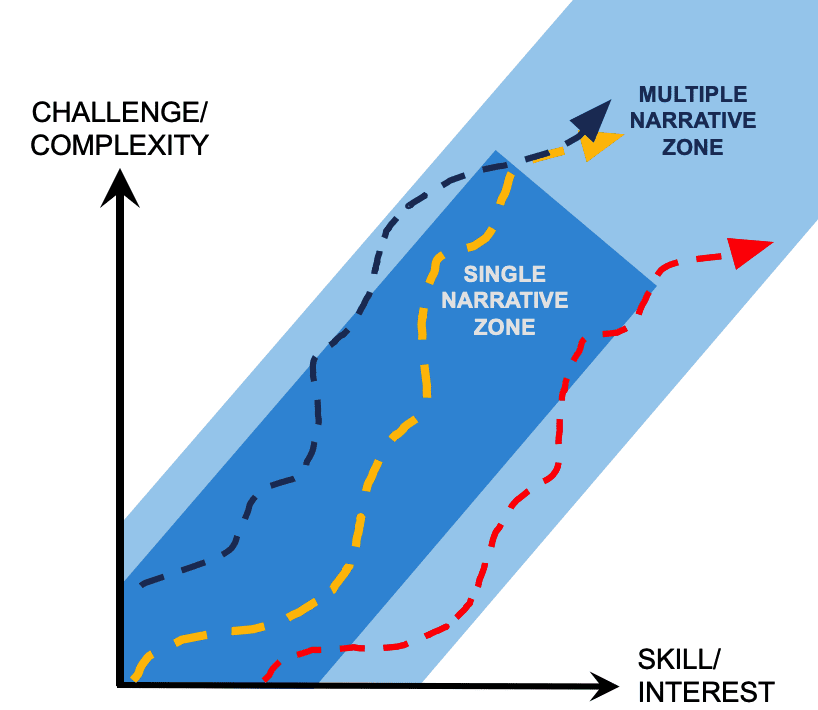
Multiple narratives expands access points and accessibility, creating a platform for more sustainable emotional engagement.

Transmedia has inspired a new trend in complex storytelling–multiple narratives and multiple journeys to a common resolution in time, but with independent outcomes. This creates a wider narrative zone with more emotional entry points (shown in light blue) that increases tolerance of narrative deviation within the canon and supports more sustainable engagement.


References

Rutledge, P. (2019). Transmedia Psychology: Creating Compelling and Immersive Experiences. In M. Freeman & R. R. Gambarato (Eds.), Routledge Companion to Transmedia Studies. London: Routledge.

  • Facebook
  • Twitter
  • Reddit
  • LinkedIn
  • E-Mail

About The Author

Pamela Rutledge, PhD, MBA is the Director of the Media Psychology Research Center. A consultant, author, speaker, and professor, she consults on a variety of media projects developing audience engagement and brand storytelling strategies.

Leave a reply

Your email address will not be published. Required fields are marked *

This site uses Akismet to reduce spam. Learn how your comment data is processed.

FOR THE PRESS

Dr. Pam Rutledge, media psychologistDr. Pamela Rutledge is available to reporters for comments on the psychological and social impact of media and technology on individuals, society, organizations and brands.  pamelarutledge@gmail.com

SEARCH THE SITE

RECENT POSTS

  • The Legacy of Daytime Talk Shows Lives in Your Feed
  • Oprah's High Road: Diverging Paths in Daytime Talk Shows
  • Daytime Talk Shows: Why We Couldn’t Look Away
  • FAFO Parenting: Letting Kids Learn the Hard Way
  • Meta Is Using Your AI Chats to “Personalize Your Experience”

MEDIA PSYCHOLOGY RESEARCH

The Media Psychology Research Center (MPRC) is an independent research organization directed by Dr. Pam Rutledge.  Read about MPRC at www.mprcenter.org.

CONSULTING PROJECTS

Dr. Rutledge consults on a variety of media projects using psychology to translate data into human behavior for powerful results.

  • Parenting in a Digital World webinar series
  • Persona Development for audience segmentation
  • Fan and Audience Engagement: Identifying audience narratives to satisfy needs
  • Brand Storytelling: Supercharging brand meaning

RECENT POSTS

  • The Legacy of Daytime Talk Shows Lives in Your Feed
  • Oprah's High Road: Diverging Paths in Daytime Talk Shows
  • Daytime Talk Shows: Why We Couldn’t Look Away
  • FAFO Parenting: Letting Kids Learn the Hard Way
  • Meta Is Using Your AI Chats to “Personalize Your Experience”

SEARCH

Content copyright Pamela Rutledge 2026.