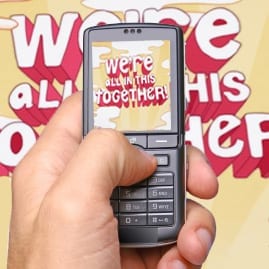
The in-flight safety message on a recent Virgin America flight ended with a clever info-cartoon intended to raise awareness of how obnoxious airplane behavior impacts everyone on the flight called “We’re all in this together.”
This is a message in short supply today. We should take a cue from Virgin America & Method (who co-sponsored the message). Instead of politicians trying to convince voters that the other guy is the problem, or, like after the London riots or the BART cell phone shut down, that access to communications tools is dangerous, we need a new mindset. It’s time for a Public Service Announcement that focuses on the strengths that come from unity; a nationwide public relations campaign based on the understanding that we are all in this together.

"We're all in this together" from Virgin America & Method info-cartoon
Social media and communications technologies are in everyone’s sights. Technology does contribute to what David Altheide (2010) calls the ‘politics of fear.’ He talks about it in terms of the ubiquitous expansion of surveillance. Technology also allows bad news to spread fast. Bad news produces fear and uncertainty—from local concerns like potential job loss or inadequate retirement funds to global anxiety recalling images of the Stock Market Crash and the Great Depression. Bad news spreads fast because emotions are contagious whether they are facilitated by social media or pamphlets. Fear is an emotion, in fact, one of the most powerful emotions we experience.
Speaking to threats, taking away rights and looking for someone to ‘blame’ send and reinforce powerful and dangerous messages of fear. It will certainly get people’s attention, but if people are afraid and feel powerless, one of three things happens: 1) the act of destruction becomes an act of agency, 2) they give away more rights to feel “safe;” or 3) they seek out a segment of society to blame.
Media is a powerful tool. Let’s use it to bring people together, not drive them apart. Let’s remind people that:
- Freedom is precious—it is worth fighting for, not against. You don’t get more freedom by violating the right so of others, whether you’re a government agency or a rioter.
- We’re all in this together. This is not a zero-sum game. If we, as a society, grow and flourish, there is more for us all.
Psychologically as well as biologically fear serves to warn us of danger. The human brain is hardwired to pay attention to these warnings to ensure our survival. Our rapt attention to bad news is the coping mechanism of information gathering—paying attention to news and other media—in order to find some certainty and make some sense out of the whole mess to manage the fear and figure out if there really is any danger. The human brain also seeks order, because order represents predictability. Predictability increases safety. Yet, while economic news may have personal consequences, what is going on is somewhere between complex and unintelligible and solutions far beyond the reach of the individual. We, for better or worse, rely on government and financial structures to manage our fiscal health. So we are left not only fearful, but helpless. What is not in our control is, by definition, less predictable. This escalates the fear because there is little more frightening than when our future well-being is out of our hands, putting us somewhere between Alice’s Looking Glass and Kafka’s Trial.
All of these things are exacerbated with knee-jerk policy decisions and political rhetoric . No matter which side of any argument you’re on, people make investment decisions in EVERYTHING based on predictability — investments of time, emotions, and effort not just money. Behavioral economists have won Nobel Prizes showing that peoples’ understanding of probability is inaccurate and that they rely on heuristics. While we could debate whether the definition of optimal risk and reward to an economist is the same as ‘optimal’ to someone balancing a complex interpersonal and socioeconomic environment, that isn’t the point. People are still trying to make the best judgments they can about what to do — ‘rational’ or not.
Fear hampers our cognitive and moral capacities. It makes us worry about ‘not enough’ and about ‘losing what’s ours.’ It creates a divisive, us-versus-them environment that influences our behavior — and not for the better. It also makes us extremely vulnerable to those who offer solutions in the guise of usurping individual freedoms. Fear creates a narrative that ‘control is necessary to keep us safe.’
When authority figures play on that fear by warning of worse calamities, taking away rights, or responding to a protest with cadres of riot gear, they are adding to the problem no the solution. They are diverting the attention of the public away from the real issues. In the case of the BART station protests, the over- and possibly unconstitutional – reaction by BART of shutting down cell service not only obscures the purpose of the original protest—the circumstances surrounding the shooting of Oscar Grant by Bay Area Rapid Transit police—but turns all of BART into bad guys instead of isolating and addressing a problem incident. It also distracts us from the blatant disregard of people for their fellow citizens in the looting, arson, or other costly damage of protests that escalate to social disruption and violence rather than engender dialogue. In a society where social media can bring people together quickly, it can also let people know when what they are doing has crossed the line. (See “Twitter Users Blast the London Rioters.”)
It’s time to let the politicians, the government, and the media, know that using fear and blame to get people’s attention and votes is not okay. It may succeed in getting people elected or products sold, but it undermines our social cohesion turns us into a nation of ‘us’ versus ‘them’ instead of ‘we’.
—-
Altheide, D. (2010). Risk Communication and the Discourse of Fear. [Article]. Catalan Journal of Communication & Cultural Studies, 2(2), 145-158. doi: 10.1386/cjcs.2.2.145_1
The talented California based animation studio Three Legged Legs created the commercial for Method & Virgin America

 Dr. Pamela Rutledge is available to reporters for comments on the psychological and social impact of media and technology on individuals, society, organizations and brands.
So true Pam! Well said. Too often media has a money-making agenda that doesn’t serve society’s best interest. That is, too often there is a focus on division instead of creating unity.
Dear Dr. Rutlege,
I come to your A Think Lab via a link from Kathy Hansen’s website http://astoriedcareer.com/
I look forward to following your research and commentary. I write this the day after City of Oakland Police used tear gas and beanbag bullets to disperse Occupy Oakland.
Yes, social media is not yet controlled and distorted as TV Network News and Cable programming is now. I remember when CBS News was folded in with CBS Entertainment.
I’m retired now from a lifetime of teaching and counseling children. My entire career, and now my sunset years, is immersed in the cheery challenge of trying to keep up with the kids!
My personal way of keeping up now is to employ multimedia technology to encourage people to use their digital cameras and computers to tell their stories.
I’m not looking to expand the customer base. I’m looking to facilitate family storytelling using these marvelous consumer level digital tools.
I’m glad bright people like you are noticing the larger picture, that powerful forces manipulate the story we hear and see every day.
Social media is a creation of technology-I wonder if the same powerful forces will find a way to co-opt it as well.