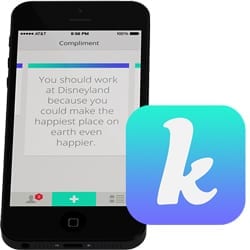
 Earlier this month, I learned about a new iPhone app called Kindr. Kindr makes it easy for you to send compliments to people you know by providing you with a ‘compliment menu,’ linked to your address book. It is based on the premise, well documented in the psychology literature, that you can make the world a better place by spreading good will.
Social connection and validation are primary drivers of human behavior. When we feel valued, we are happier. When we’re happier, the people around us are likely to be, too. The folks at Kindr are talking advantage of the power of social technologies by encouraging people to share compliments. Emotions can travel on networks just like YouTube videos.
Social connection and validation are primary drivers of human behavior. When we feel valued, we are happier. When we’re happier, the people around us are likely to be, too. The folks at Kindr are talking advantage of the power of social technologies by encouraging people to share compliments. Emotions can travel on networks just like YouTube videos.

Initially, I had my doubts. I feared that canned compliments in this ‘age of authenticity,’ however well-intentioned, would feel like empty Hallmark platitudes. The Kindr app, however, comes with some surprisingly clever compliments. I’m not sure I’d send “You make an awesome grilled cheese sandwich. Seriously. Awesome” to someone I didn’t know because of the lack of context (although, come to think of it, my Dad makes an awesome grilled cheese sandwich). However among a group of friends who know about the app, I think it could get a lot of play. If compliments don’t do it for you, you can also just read happy news stories, but the real power is in being appreciated by someone you know. So if you don’t like the ones they provide, make your own. The payoff comes in the neural response of increased dopamine and oxytocin so you not only feel happier, you also feel more connected.
I got very excited, however, in thinking how Kindr would be brilliant at the center of a middle or high school media literacy lesson on digital citizenship. Rather than just lecture kids about the perils of online behavior, let’s let kids think about the full range of potential in human communication, not just the dark side. Where are the boundaries? What happens to meaning when words travel independent of facial expressions? Kindr would let kids appreciate the physical response when they receive compliments, courtesy of their evolutionary brains. An interesting assignment might talk about what makes a good compliment—context, gender, culture, etc.–and then develop some of their own. Have them see what it feels like to send compliments to each other for a week. At the very least, introducing Kindr to a classroom would change the energy and spread a little happiness. Positive emotions increase creativity, problem solving, trust and resilience—a perfect time to have kids brainstorm how to handle cyberbullying.

We don’t often stop to ponder the profound difference networked communications make, compared to the traditional top-down, uni-directional model. Every parent and teacher, however, can appreciate how quickly cold germs spread in a kindergarten class with a bunch of short-attention, energetic children running around, sharing toys, making buddies, and touching everything in sight. In that same way, social media leverages sharing behaviors by spreading information and that makes it very potent. Information on the social net is permanent, searchable and uncontrollable. It is one of the reasons why we worry about the potential damage of cyberbullying. It is also why efforts to exploit the happy side can make a big difference.
In 2008, Fowler and Christakis made headlines by showing how happiness spreads through social networks. How close you are to the happy people matters. A happy neighbor, for example, increases your chances of being happy by 34%. While happiness isn’t the only emotion that spreads, of course, a happy contact increases a person’s odds of being happy more than an unhappy contact decreases it. And this is just LOL cats and general good cheer. Not someone appreciating you by being Kindr.
—-
Fowler, J.H., and Christakis, N.A. (2008) Dynamic spread of happiness in a large social network: longitudinal analysis over 20 years in the Framingham Heart Study. (337) BMJ
A version of this post was published on PsychologyToday.com in Positively Media.

 Dr. Pamela Rutledge is available to reporters for comments on the psychological and social impact of media and technology on individuals, society, organizations and brands.
The Kindness App: Send Compliments with Kindr: Earlier this month, I learned about a new iPhone app called Kindr…. http://t.co/TSWmLf4Lt2
With all of the cyberbullying – here is a positive app – The Kindness App: Send Compliments with Kindr http://t.co/156NfpdhOO
Lorel Durant liked this on Facebook.
Cynthia Hagan liked this on Facebook.
How did you feel the last time someone did something kind for you? Pass it on… http://t.co/iewLhi6NIr
RT @mediapsychology: The Kindness App: Send Compliments with Kindr: Earlier this month, I learned about a new iPhone app called Kindr…. h…
The Kindness App: Send Compliments with Kindr http://t.co/kU5jYiyXPt #iphoneapp #app #socialconnection #happylife #beautiful
[…] Her latest post looks at the new iPhone app Kindr and explores what it means to be kind on social media. It is “… well documented in the psychology literature, that you can make the world a better place by spreading good will.” […]