
I had a great time participating on a panel at SxSW with Anastasia Goldstein, Catherina O’Gorman (Think Love.org), Kevin Hansen (SecretRegrets.com), and Veer Gadwaney (DailyFeats.com) . (See the visual map of the panel discussion in a previous post). Here is an overview of my comments:
Our panel asked the question: Does the Internet make you happy? My answer was ‘No.’ Let me tell you why.
 First, happiness is not about the tools.
Second, happiness comes from within.
We have to get over asking what does technology “does to us” and start asking what we, as humans, are trying to do—individually and as members of a global community—and how technology can help.
When I say happiness comes from ‘within,’ I’m talking about the brain. Humans are subject to “impact bias” which means that we always think things and events are going to make us happy, but that isn’t the case. Most of what we feel comes to us from sensory input from unconscious portions of the brain—our instinctual lizard brain or our emotional mammalian brain.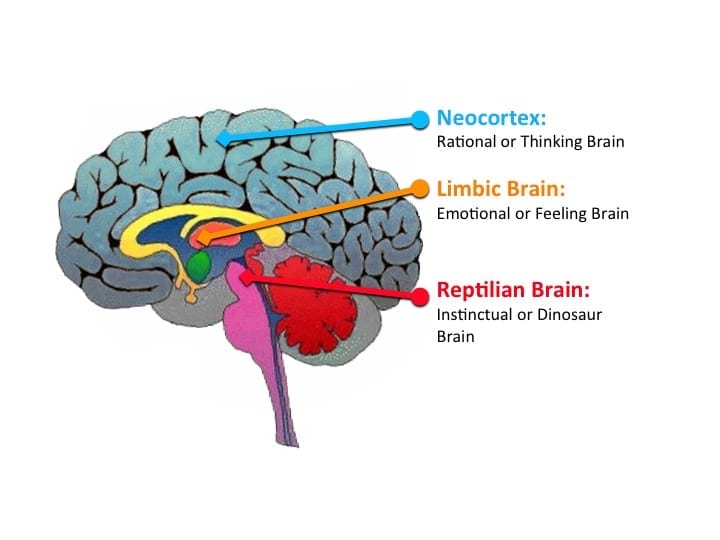
Up at the top is the neocortex, the conscious brain, blissfully going along on the assumption that it’s in charge when it’s really mostly responding to pops of oxytocin or dopamine. But the rational brain excels as an interpreter and planner; its job is to make a story that fits with sensory input in a way that makes sense with our stored previous experience and context. At the lizard level, we don’t distinguish readily between real and virtual in our visceral response. Consequently, what we experience online that triggers and satisfies basic human needs, such as connection, affiliation, group membership, and social validation—may be technically ‘virtual’ but they are interpreted as meaningful experience by the lizard brain. 
Try this: Imagine a lemon, a big, juicy one. Imagine that I’m going to squeeze the lemon. The juice is coming out and a drop of it falls on your tongue.
Did you salivate? Did you smell lemon? Did your nose crinkle? All of these are lizard brain reactions to images in your mind—to a virtual world that taps your personal database of experience and metaphors. Just like with interactive technology.
The Psychology of Happiness
Martin Seligman, the father of positive psychology created a formula for happiness (H).

H equals S “set point” plus C “circumstances” plus V “voluntary activity.” (Leave it to an academic to make even happiness sound sort of grim.)
‘Set Point” is your biology. Blame the animal consortium in your brain or your mother and father. Each of us has a biological range of happiness, just like extroversion and introversion, which determines our basic degree of optimism. Some people are just naturally happier than others. It’s adjustable, but it takes work. (Also, before you get down on yourself for not being continually happy, remember that, biologically, we are wired to notice danger and react much more powerfully to fear. In the wild, there wasn’t much upside in noticing the flowers compared to the downside of missing the tiger.)
‘Circumstances’ are, like it sounds, our context or environment. Those are often out of our control. Over time, however, the human brain frequently reframes negative experience into a more positive light.
That brings us to “V” for voluntary activities. This is important because these are the things you can control. And this is where the Internet really delivers.
We can look at Internet impact through the lens of positive psychology. Researchers have identified critical areas that contribute to happiness. I said earlier that the Internet doesn’t make you happy. It doesn’t make you sad either. The Internet is just a tool, and it reflects and sometimes amplifies human activity and goals, which haven’t changed much since we grew our neocortex. As a tool, though, the Internet is a game changer in how it facilitates activities that can make you happy.
Most importantly, these things can positively impact all areas of life, not just Internet-based activities.
- Voice: The belief that you have a right to speak—today, it doesn’t matter who you are. Social media and a networked globe have changed the nature of the social power structure.
- Connection: The Internet connects us; this allows us to expand our social circles, build social capital, social support, group affiliation and identity, and have our existence and ideas validated by others in ways never before possible.
- Social validation: Social validation increases our sense of agency. Agency is about taking action and having it matter; being able to act on your environment with results.
- Agency: Belief that your actions matter encourages us to take risks and engage, leading to self-efficacy, motivation, and flow.
- Self-efficacy: Self-efficacy is the belief that you are capable of meeting the challenges you face and this leads to resilience in the face of adversity and increased optimism.
There is a long list of the most common things that people say make them happy: for example, seeing children smile, puppies, laughing, helping others, connecting with others, love, freedom, choice, play, gratitude, competence, good health, and sex. All of these, except arguably “sex,” can be facilitated by or experienced on the Internet.
But ultimately, what we’re talking about is human strengths—the ability to take action and believe it matters, whether it’s getting health information, learning social skills, writing fan fiction, or playing World of Warcraft. When we look at the impact of technology, we have to change how we ask the questions.
To loosely paraphrase a famous quote from Eleanor Roosevelt, no one could make us feel things–good or bad–without our help. Technology doesn’t exist in isolation from the human system–and we need to recognize and take responsibility for our part in that system, too. Let’s start asking what we, as individuals and as members of a global community—are trying to do and how the technology can help.

 Dr. Pamela Rutledge is available to reporters for comments on the psychological and social impact of media and technology on individuals, society, organizations and brands.