DR. PAM | MEDIA PSYCHOLOGIST
THE PSYCHOLOGY OF DIGITAL BEHAVIORS
  • Home
  • Blog
  • About
    • About Dr. Pamela Rutledge
    • Media Psychology
      • What Is A Media Psychologist?
      • 8 Reasons Why We Need Media Psychology
      • Careers in Media Psychology
      • Example Careers in Media Psychology
      • Media Psychology at Fielding Graduate University
      • Positive Media Psychology
    • MPRC
      • Media Psychology Research Center
    • Media Psychology Review
  • Consulting
    • Speaking & Consulting
    • Audience Engagement: Why Use Personas?
      • How to Build a Persona
    • Adapting to Change
    • Transmedia Storytelling
      • Storytelling Across Platforms
      • Transmedia Storytelling Starts with the Power of Story
      • Our Transmedia World
      • Transmedia Case Study: The Three Little Pigs
      • Transmedia Storytelling Workshop
  • Story Power
    • Brand Storytelling
    • Storytelling: Brands, Entertainment & Organizations
      • Storytelling for Organizations
      • Core Story: Case Study
  • In the News
    • Press Quotes & Interviews 2022-2025
    • 2021-2019
    • 2018-2016
    • 2016-2017
    • 2015-2013
    • 2012 & EARLIER
    • Video Interviews & Webinars
  • Resources
    • Mindful Media & Digital Literacy
      • Positive Media Psychology
      • Benefits of Video Games Part 1
      • Benefits of Video Games Part 2
      • Benefits of Video Games Part 3
      • Becoming Mindful: Exercises
      • Mindful Media Journal
    • Academic Materials
      • Media Psychology Syllabus 2021
      • Media Psychology Syllabus 2012
      • Media Psychology Syllabus 2015
    • Articles
      • Persuasion & Augmented Reality
      • Psychology of Transmedia Engagement
      • Theories of Attention
      • The Psychology of Color
      • Website Design: How to Use Psych Theory
      • Data Strategy: Listen to Your Consumers’ Stories
      • The Psychology of Story
  • Archives
  • Contact
DR. PAM | MEDIA PSYCHOLOGIST
  • Home
  • Blog
  • About
    • About Dr. Pamela Rutledge
    • Media Psychology
      • What Is A Media Psychologist?
      • 8 Reasons Why We Need Media Psychology
      • Careers in Media Psychology
      • Example Careers in Media Psychology
      • Media Psychology at Fielding Graduate University
      • Positive Media Psychology
    • MPRC
      • Media Psychology Research Center
    • Media Psychology Review
  • Consulting
    • Speaking & Consulting
    • Audience Engagement: Why Use Personas?
      • How to Build a Persona
    • Adapting to Change
    • Transmedia Storytelling
      • Storytelling Across Platforms
      • Transmedia Storytelling Starts with the Power of Story
      • Our Transmedia World
      • Transmedia Case Study: The Three Little Pigs
      • Transmedia Storytelling Workshop
  • Story Power
    • Brand Storytelling
    • Storytelling: Brands, Entertainment & Organizations
      • Storytelling for Organizations
      • Core Story: Case Study
  • In the News
    • Press Quotes & Interviews 2022-2025
    • 2021-2019
    • 2018-2016
    • 2016-2017
    • 2015-2013
    • 2012 & EARLIER
    • Video Interviews & Webinars
  • Resources
    • Mindful Media & Digital Literacy
      • Positive Media Psychology
      • Benefits of Video Games Part 1
      • Benefits of Video Games Part 2
      • Benefits of Video Games Part 3
      • Becoming Mindful: Exercises
      • Mindful Media Journal
    • Academic Materials
      • Media Psychology Syllabus 2021
      • Media Psychology Syllabus 2012
      • Media Psychology Syllabus 2015
    • Articles
      • Persuasion & Augmented Reality
      • Psychology of Transmedia Engagement
      • Theories of Attention
      • The Psychology of Color
      • Website Design: How to Use Psych Theory
      • Data Strategy: Listen to Your Consumers’ Stories
      • The Psychology of Story
  • Archives
  • Contact
Feb 16

Levi’s: Go Forth and Exploit, Part 1

  • February 16, 2011
  • Pamela Rutledge
  • 1 Comment

By Pamela Rutledge and Bonnie Buckner

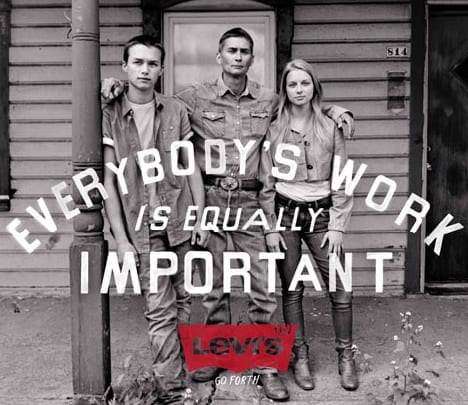
The Levi’s Go Forth/We Are All Workers Campaign has focused a lot of attention on the town of Braddock, PA. Levi’s uses Braddock to frame a struggling former steel town with a Depression-era narrative. Levi’s linked the culturally iconic metaphor of the Depression with their jeans through story. While branding through storytelling is a powerful communication device, we find the Levi’s campaign questionable and alarming on multiple levels.Levi's Great Depression Campaign

Drawing parallels between the recession of today and the Great Depression is not only inaccurate but dangerous. It contributes to a public sentiment of fear and anxiety. There are many people struggling right now, but as those who lived through 1930s will tell you, we’re not there. At the depths of the Great Depression from 1929-1930, US unemployment was 25%, crop prices fell by nearly 60%, industrial production was down 46%, foreign trade dropped 70%, and the stock market lost nearly 90% of it’s value. At the beginning of 1939, the Dow Jones Industrial Average was 133. Today, the Dow is over 12,000, US unemployment is around 9%, and we have rising foreign trade and commodities prices. In other words, the Depression was really, really, really bad compared to where we are today.

In their campaign, Levi’s has romanticized the Depression era through their beautiful, moody black and white photography, and trivialized the experience of those who suffered through it in the process. By invoking the “Grapes of Wrath” metaphor, Levi’s has implied that we are,as a country, facing similar hardships by linking those images with narratives and slogans like “We are all workers” and “Go Forth to Work”.

The American people have incredible resilience, and have, by necessity rebuilt, renewed, and reinvented themselves, their communities, and the country. This is an attribute to be respected, heralded, and fostered. We are firmly in favor of companies who use their advertising dollars to promote optimism and pride and to increase awareness of others’ problems. Those are campaigns that support necessary profit motives with social concern.  However, Levi’s fell prey to marketing hubris in creating the stylized, slick videos in the Go Forth campaign which are so ‘artsy’ that they become a mockery rather than a celebration of human strength. In fact, many have reacted to this campaign by creating and posting parodies of the Go Forth videos on YouTube. We know emotions are contagious. There is no excuse for spreading depression.

Braddock, PA

Life is tough in Braddock, Pennsylvania and has been since the steel mills closed. Instead of touching emotion, the Levi’s campaign feels like manipulation and exploitation of the very people it pretends to promote.

Levi’s shows us scenes mimicking the Great Depression with real people from Braddock wearing Levis, dressed up to look cool, gritty, and stylish in that dusty, Steinbeck, sweaty, shirtless kind of way, with quotes from great American authors providing a poetic dressing about helping people. Levi’s then adds insult to injury by running a parallel campaign with the same stylishly gritty visual format presenting a very sexualized juxtaposition of images with cultural metaphors of the Depression era. This brings to mind an equally off-putting, visually similar (and brand-detracting) 2006 M. Gondry video using the same smirky cognitive dissonances centered around a Depression-era young man picking up his date with references to the Levi’s condom pocket.

In spite of the multiple points of entry to the campaign and a confusing number of slogans, they all occupy the same visual and metaphorical space under the brand umbrella of Levi’s and, as such, become the same message, for better or worse. The net result is a meaning that is insulting to not just Braddock but all of us: “Poor is the new sexy, it’s even erotic.” Guess what – it’s not.

Many have called attention to what is perceived as the hypocrisy of Levi’s, who, since 2002, operates almost entirely overseas. Is it their job to move back over here? No. But it is pretty tacky to use a town’s lost manufacturing base as its campaign to sell jeans. It also does an injustice to the town of Braddock and the efforts they have made to proactively pursue revitalization by attracting new residents due to the availability inexpensive homes for restoration, encouraging artists to come with promises of studio and gallery space, and other creative efforts to populate the town and bring in new ideas. (See the NY Times Magazine article Mayor of Rust.

The Levi’s campaign isn’t respectful of the people of Braddock. It makes light of their situation by, first, stereotyping their individual humanity through the use of the powerful Depression-era metaphors. Second, it exploits their dignity by fitting Braddock into the Levi narrative, rather than using the Levi narrative to bring awareness to their challenges and propose a solution (beyond being grittily sexy).

In Part 2, we’ll talk about the missed branding and social opportunities and the Karma Capital that got away.


  • Facebook
  • Twitter
  • Reddit
  • LinkedIn
  • E-Mail

About The Author

Pamela Rutledge, PhD, MBA is the Director of the Media Psychology Research Center. A consultant, author, speaker, and professor, she consults on a variety of media projects developing audience engagement and brand storytelling strategies.

1 Comment

  1. Levi Strauss: How An American Classic Lost Its Plot - Brand Stories - New Age Brand Building - Brand Storytelling
    August 12, 2012 at 4:49 pm ·

    […] http://athinklab.com/2011/02/16/levis-go-forth-and-exploit-part-1/ jQuery(document).load(function(){ stLight.options({publisher:''}); });emailprintDigg Diggvar dd_offset_from_content = 40; var dd_top_offset_from_content = 0; /* Tags: brand, Levi Strauss Retweet ThisShare ThisStumbleUpon ThisDigg ThisBookmark This […]

Leave a reply

Your email address will not be published. Required fields are marked *

This site uses Akismet to reduce spam. Learn how your comment data is processed.

FOR THE PRESS

Dr. Pam Rutledge, media psychologistDr. Pamela Rutledge is available to reporters for comments on the psychological and social impact of media and technology on individuals, society, organizations and brands.  pamelarutledge@gmail.com

SEARCH THE SITE

RECENT POSTS

  • The Legacy of Daytime Talk Shows Lives in Your Feed
  • Oprah's High Road: Diverging Paths in Daytime Talk Shows
  • Daytime Talk Shows: Why We Couldn’t Look Away
  • FAFO Parenting: Letting Kids Learn the Hard Way
  • Meta Is Using Your AI Chats to “Personalize Your Experience”

MEDIA PSYCHOLOGY RESEARCH

The Media Psychology Research Center (MPRC) is an independent research organization directed by Dr. Pam Rutledge.  Read about MPRC at www.mprcenter.org.

CONSULTING PROJECTS

Dr. Rutledge consults on a variety of media projects using psychology to translate data into human behavior for powerful results.

  • Parenting in a Digital World webinar series
  • Persona Development for audience segmentation
  • Fan and Audience Engagement: Identifying audience narratives to satisfy needs
  • Brand Storytelling: Supercharging brand meaning

RECENT POSTS

  • The Legacy of Daytime Talk Shows Lives in Your Feed
  • Oprah's High Road: Diverging Paths in Daytime Talk Shows
  • Daytime Talk Shows: Why We Couldn’t Look Away
  • FAFO Parenting: Letting Kids Learn the Hard Way
  • Meta Is Using Your AI Chats to “Personalize Your Experience”

SEARCH

Content copyright Pamela Rutledge 2026.