DR. PAM | MEDIA PSYCHOLOGIST
THE PSYCHOLOGY OF DIGITAL BEHAVIORS
  • Home
  • Blog
  • About
    • About Dr. Pamela Rutledge
    • Media Psychology
      • What Is A Media Psychologist?
      • 8 Reasons Why We Need Media Psychology
      • Careers in Media Psychology
      • Example Careers in Media Psychology
      • Media Psychology at Fielding Graduate University
      • Positive Media Psychology
    • MPRC
      • Media Psychology Research Center
    • Media Psychology Review
  • Consulting
    • Speaking & Consulting
    • Audience Engagement: Why Use Personas?
      • How to Build a Persona
    • Adapting to Change
    • Transmedia Storytelling
      • Storytelling Across Platforms
      • Transmedia Storytelling Starts with the Power of Story
      • Our Transmedia World
      • Transmedia Case Study: The Three Little Pigs
      • Transmedia Storytelling Workshop
  • Story Power
    • Brand Storytelling
    • Storytelling: Brands, Entertainment & Organizations
      • Storytelling for Organizations
      • Core Story: Case Study
  • In the News
    • Press Quotes & Interviews 2022-2025
    • 2021-2019
    • 2018-2016
    • 2016-2017
    • 2015-2013
    • 2012 & EARLIER
    • Video Interviews & Webinars
  • Resources
    • Mindful Media & Digital Literacy
      • Positive Media Psychology
      • Benefits of Video Games Part 1
      • Benefits of Video Games Part 2
      • Benefits of Video Games Part 3
      • Becoming Mindful: Exercises
      • Mindful Media Journal
    • Academic Materials
      • Media Psychology Syllabus 2021
      • Media Psychology Syllabus 2012
      • Media Psychology Syllabus 2015
    • Articles
      • Persuasion & Augmented Reality
      • Psychology of Transmedia Engagement
      • Theories of Attention
      • The Psychology of Color
      • Website Design: How to Use Psych Theory
      • Data Strategy: Listen to Your Consumers’ Stories
      • The Psychology of Story
  • Archives
  • Contact
DR. PAM | MEDIA PSYCHOLOGIST
  • Home
  • Blog
  • About
    • About Dr. Pamela Rutledge
    • Media Psychology
      • What Is A Media Psychologist?
      • 8 Reasons Why We Need Media Psychology
      • Careers in Media Psychology
      • Example Careers in Media Psychology
      • Media Psychology at Fielding Graduate University
      • Positive Media Psychology
    • MPRC
      • Media Psychology Research Center
    • Media Psychology Review
  • Consulting
    • Speaking & Consulting
    • Audience Engagement: Why Use Personas?
      • How to Build a Persona
    • Adapting to Change
    • Transmedia Storytelling
      • Storytelling Across Platforms
      • Transmedia Storytelling Starts with the Power of Story
      • Our Transmedia World
      • Transmedia Case Study: The Three Little Pigs
      • Transmedia Storytelling Workshop
  • Story Power
    • Brand Storytelling
    • Storytelling: Brands, Entertainment & Organizations
      • Storytelling for Organizations
      • Core Story: Case Study
  • In the News
    • Press Quotes & Interviews 2022-2025
    • 2021-2019
    • 2018-2016
    • 2016-2017
    • 2015-2013
    • 2012 & EARLIER
    • Video Interviews & Webinars
  • Resources
    • Mindful Media & Digital Literacy
      • Positive Media Psychology
      • Benefits of Video Games Part 1
      • Benefits of Video Games Part 2
      • Benefits of Video Games Part 3
      • Becoming Mindful: Exercises
      • Mindful Media Journal
    • Academic Materials
      • Media Psychology Syllabus 2021
      • Media Psychology Syllabus 2012
      • Media Psychology Syllabus 2015
    • Articles
      • Persuasion & Augmented Reality
      • Psychology of Transmedia Engagement
      • Theories of Attention
      • The Psychology of Color
      • Website Design: How to Use Psych Theory
      • Data Strategy: Listen to Your Consumers’ Stories
      • The Psychology of Story
  • Archives
  • Contact
Feb 24

Gossip Girl as a Parenting Tool

  • February 24, 2009
  • Pamela Rutledge
  • No Comments

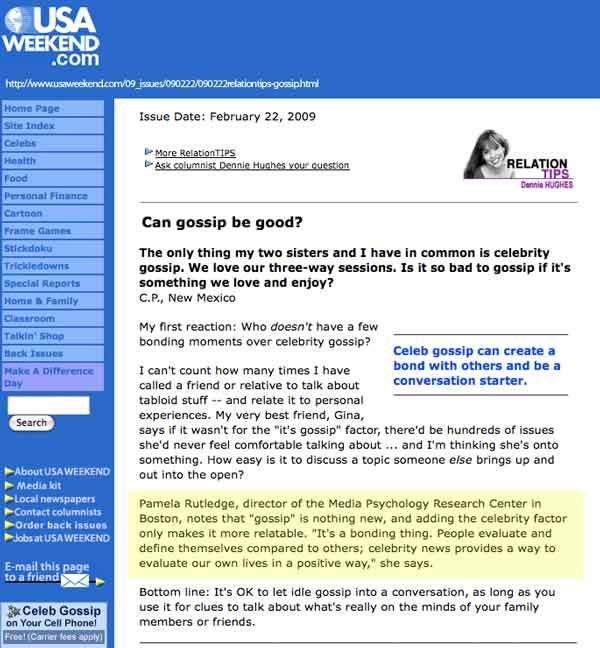
In a brief Q&A (2/22/09) in USA Today Weekend by advice columnist Dennie Hughes, she quotes me saying it’s okay to indulge in celebrity gossip. I think most people tend to dismiss gossip as pretty shallow stuff, in spite of what we read at the dentist’s office. And that might be true, except for the fact that the essence of the gossip experience lies in both the shared experience and all the other information that is exchanged when we gossip about anything. That information is all about connecting with others, defining and sharing our own identity, and exploring our place in society. You can dissect personality, culture, good fortune, effort, connection, and human success and frailty, not to mention plumage, at a safe distance. Gossip provides the laboratory for investigation. Research from around the world shows that soap opera plots and characters successfully introduce subjects that are outside the boundaries of normal discourse or go against cultural norms in ways that can improve understanding, tolerance, and opportunity. Soap operas are just scripted gossip. Why not take advantage of the real thing?

We are awash in people arguing that media technologies have a detrimental influence on how we view the world based on various psychological theories (i.e. priming, framing, social learning theory and social modeling, social constructionism). But people, even kids believe it or not, are sentient, caring beings with the ability to act and think by their own volition. If we are truly worried that mass media images, behaviors, and celebrities have so much influence on our kids and cultural expectations, why not talk about them? What better way to engage your child or teen in a conversation about values, behavior and consequences than by discussing them? (*** Note to parents: discussing means you LISTEN not just talk***.) Simple questions can get you a long way into a discussion with your kids.

  • What happened?
  • Why do you think people do that?
  • How do people handle stuff like that?
  • What does it mean for their life now?
  • What would you do?
  • If the gossip is mean-spirited, talk about that too.

You might be shocked at what your kids will tell you if they think you are trying to hear them. At the very least, you are showing your kids you are trying to understand their world and their perspective. Not such a bad thing to do a little social modeling of an interested parent.
2009-02-22-pr-usaweekend

Reblog this post [with Zemanta]
  • Facebook
  • Twitter
  • Reddit
  • LinkedIn
  • E-Mail

About The Author

Pamela Rutledge, PhD, MBA is the Director of the Media Psychology Research Center. A consultant, author, speaker, and professor, she consults on a variety of media projects developing audience engagement and brand storytelling strategies.

Leave a reply

Your email address will not be published. Required fields are marked *

This site uses Akismet to reduce spam. Learn how your comment data is processed.

FOR THE PRESS

Dr. Pam Rutledge, media psychologistDr. Pamela Rutledge is available to reporters for comments on the psychological and social impact of media and technology on individuals, society, organizations and brands.  pamelarutledge@gmail.com

SEARCH THE SITE

RECENT POSTS

  • The Legacy of Daytime Talk Shows Lives in Your Feed
  • Oprah's High Road: Diverging Paths in Daytime Talk Shows
  • Daytime Talk Shows: Why We Couldn’t Look Away
  • FAFO Parenting: Letting Kids Learn the Hard Way
  • Meta Is Using Your AI Chats to “Personalize Your Experience”

MEDIA PSYCHOLOGY RESEARCH

The Media Psychology Research Center (MPRC) is an independent research organization directed by Dr. Pam Rutledge.  Read about MPRC at www.mprcenter.org.

CONSULTING PROJECTS

Dr. Rutledge consults on a variety of media projects using psychology to translate data into human behavior for powerful results.

  • Parenting in a Digital World webinar series
  • Persona Development for audience segmentation
  • Fan and Audience Engagement: Identifying audience narratives to satisfy needs
  • Brand Storytelling: Supercharging brand meaning

RECENT POSTS

  • The Legacy of Daytime Talk Shows Lives in Your Feed
  • Oprah's High Road: Diverging Paths in Daytime Talk Shows
  • Daytime Talk Shows: Why We Couldn’t Look Away
  • FAFO Parenting: Letting Kids Learn the Hard Way
  • Meta Is Using Your AI Chats to “Personalize Your Experience”

SEARCH

Content copyright Pamela Rutledge 2026.