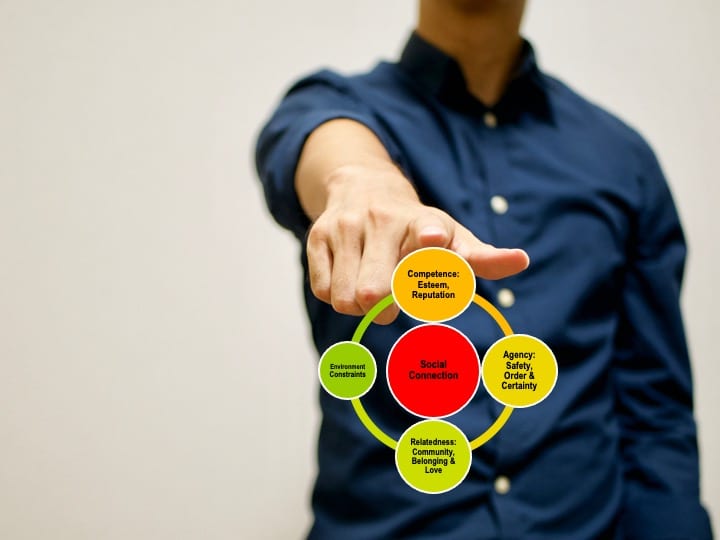
Revising Maslow: My model places social connection at the hub, as fundamental to achieving all human needs, from sex and safety to esteem.
In my November 2011 Psychology Today article “What Maslow Misses,” I argued that Maslow’s popular Hierarchy of Needs pyramid undervalues the role of social connection in human basic survival needs and, therefore, as a driver of behavior. Recently, storytelling and management guru and Forbes contributor Steve Denning picked up this idea in the context of how management can better meet the psychological needs of employees by focusing on social connection in a recent article: "What Maslow Missed."
In response to Denning’s column, Maslow scholar and executive coach Don Blohowiak objected to the simplification and misrepresentation of Maslow’s work. I very much appreciate Mr. Denning’s attention to my revision of Maslow and furthering the discussion I started. And I want to take the responsibility for any misrepresentation of Maslow’s hierarchy in “Maslow Rewired” relative to Maslow's published works. I was speaking to the common heuristic of Maslow’s work, which, as many may know, doesn’t reflect the depth of thought and understanding of a remarkable thinker and scholar. I have no doubt but that Maslow himself would be somewhere between astonished and appalled at the way his theories have been simplified, recast, reinterpreted and applied over the years. My personal favorite is the Hierarchy of Hats, but I have seen it altered to frame approaches to everything from interaction design to education and management styles.
It is not surprising that powerful ideas go, in contemporary terms, viral. As we often talk about in social technologies, the content producer doesn’t control the message — and this is true whether it’s a brand or a philosophy, Coke or Maslow.
The functional definition of brands and theories comes from the meaning the receivers make of the information they get and the experiences and context surrounding them. This is an additive process, with meaning the product of distinct bits and pieces from different things accumulated over time. There is an increasing amount of interest and attention around the idea of ‘transmedia storytelling’ these days because of our increased awareness of converging and permeable media technology boundaries, but humans have always been transmedia storytellers. Stories are the brain’s native language, giving us the ability to store the things we ‘know’ in ways that make sense by creating multi-sensory connections through our neural networks. A vast array of theorists from Mead and Vygotsky to Beck and Bandura, support what we all intuitively know: experience changes our understanding of the world, which is saying that what we experience changes the stories we tell to others and ourselves.
We get information over time, additively, from multiple sources, what we might now call ‘transmedia’, and process it based on the stories we already hold. As Mr. Denning as so brilliantly shown in his work, stories are fundamental to not just what we do, but who we are as individuals, organizations, and countries. This is a long way of saying that Maslow’s work has become a story, a significant cultural reference for many who have never and will never read his work.
The ability of Maslow’s ideas to by synthesized into a visual representation using the archetypal symbol of a pyramid has also played an important role is their dissemination and adoption because we are contributing our own understanding of symbols and visual and semantic metaphors that amplifies (and possibly distorts) the meaning. We live in a media-rich world where multi-sensory communication is the rule not the exception. It is rare to see an article about Maslow’s theory without a pyramid. The labels and number of levels sometimes vary, but our fundamental and immediate understanding of the pyramid structure is like Maslow on broadband. We get it and immediately look for ways to apply it to our own worldview. If it were not so clear, far fewer people would know of it and employ it, but without that shorthand, more might have actually read his work.
My primary point in “What Maslow Missed,” which Mr. Denning spoke to, is the widespread assumption represented by the pyramid, that human connection is NOT a primary drive and instinct, but one we worry about after we’ve found the cave, slain the wooley mammoth, or paid the heating bill. While this is not something I would attribute to Maslow himself, is it one that can be effectively addressed by tapping a well-known mental model such as the Hierarchy of Needs has become.
People seem to be surprised by the rapidity with which social tools, like Facebook or Pinterest, are adopted and they become preoccupied with and anxious about the tools themselves. In the process, they miss the import of the psychological shifts that come from not just the ability to connect and act effectively on the environment, but in knowing and believing that we can. There are significant implications in this fundamental shift for everything from the obvious, such as marketing and branding, to how we view organizational processes, such as management and education, as Mr. Denning discusses in the context of his concept of Radical Management.
I used Maslow’s hierarchy as a convenient point of reference to argue that the drivers of social connection are intimately interwoven into our basic survival, rather than an upward climb from food and shelter. So while it does a disservice to a scholar’s understanding of Maslow, I hope that it provides a glimpse into a new way of thinking about the ways that our core assumptions — our stories of who we are and how we fit into the world — shift with the empowerment of technology and the implications for communicating, engaging, and individual and society-wide expectations.
---

 Dr. Pamela Rutledge is available to reporters for comments on the psychological and social impact of media and technology on individuals, society, organizations and brands.
Full Guide
Revising Maslow’s Hierarchy for a Socially-Connected World
leather suitcases
Revising Maslow’s Hierarchy for a Socially-Connected World
приведу ссылку
Revising Maslow's Hierarchy for a Socially-Connected World
practice writing
Revising Maslow's Hierarchy for a Socially-Connected World