DR. PAM | MEDIA PSYCHOLOGIST
THE PSYCHOLOGY OF DIGITAL BEHAVIORS
  • Home
  • Blog
  • About
    • About Dr. Pamela Rutledge
    • Media Psychology
      • What Is A Media Psychologist?
      • 8 Reasons Why We Need Media Psychology
      • Careers in Media Psychology
      • Example Careers in Media Psychology
      • Media Psychology at Fielding Graduate University
      • Positive Media Psychology
    • MPRC
      • Media Psychology Research Center
    • Media Psychology Review
  • Consulting
    • Speaking & Consulting
    • Audience Engagement: Why Use Personas?
      • How to Build a Persona
    • Adapting to Change
    • Transmedia Storytelling
      • Storytelling Across Platforms
      • Transmedia Storytelling Starts with the Power of Story
      • Our Transmedia World
      • Transmedia Case Study: The Three Little Pigs
      • Transmedia Storytelling Workshop
  • Story Power
    • Brand Storytelling
    • Storytelling: Brands, Entertainment & Organizations
      • Storytelling for Organizations
      • Core Story: Case Study
  • In the News
    • Press Quotes & Interviews 2022-2025
    • 2021-2019
    • 2018-2016
    • 2016-2017
    • 2015-2013
    • 2012 & EARLIER
    • Video Interviews & Webinars
  • Resources
    • Mindful Media & Digital Literacy
      • Positive Media Psychology
      • Benefits of Video Games Part 1
      • Benefits of Video Games Part 2
      • Benefits of Video Games Part 3
      • Becoming Mindful: Exercises
      • Mindful Media Journal
    • Academic Materials
      • Media Psychology Syllabus 2021
      • Media Psychology Syllabus 2012
      • Media Psychology Syllabus 2015
    • Articles
      • Persuasion & Augmented Reality
      • Psychology of Transmedia Engagement
      • Theories of Attention
      • The Psychology of Color
      • Website Design: How to Use Psych Theory
      • Data Strategy: Listen to Your Consumers’ Stories
      • The Psychology of Story
  • Archives
  • Contact
DR. PAM | MEDIA PSYCHOLOGIST
  • Home
  • Blog
  • About
    • About Dr. Pamela Rutledge
    • Media Psychology
      • What Is A Media Psychologist?
      • 8 Reasons Why We Need Media Psychology
      • Careers in Media Psychology
      • Example Careers in Media Psychology
      • Media Psychology at Fielding Graduate University
      • Positive Media Psychology
    • MPRC
      • Media Psychology Research Center
    • Media Psychology Review
  • Consulting
    • Speaking & Consulting
    • Audience Engagement: Why Use Personas?
      • How to Build a Persona
    • Adapting to Change
    • Transmedia Storytelling
      • Storytelling Across Platforms
      • Transmedia Storytelling Starts with the Power of Story
      • Our Transmedia World
      • Transmedia Case Study: The Three Little Pigs
      • Transmedia Storytelling Workshop
  • Story Power
    • Brand Storytelling
    • Storytelling: Brands, Entertainment & Organizations
      • Storytelling for Organizations
      • Core Story: Case Study
  • In the News
    • Press Quotes & Interviews 2022-2025
    • 2021-2019
    • 2018-2016
    • 2016-2017
    • 2015-2013
    • 2012 & EARLIER
    • Video Interviews & Webinars
  • Resources
    • Mindful Media & Digital Literacy
      • Positive Media Psychology
      • Benefits of Video Games Part 1
      • Benefits of Video Games Part 2
      • Benefits of Video Games Part 3
      • Becoming Mindful: Exercises
      • Mindful Media Journal
    • Academic Materials
      • Media Psychology Syllabus 2021
      • Media Psychology Syllabus 2012
      • Media Psychology Syllabus 2015
    • Articles
      • Persuasion & Augmented Reality
      • Psychology of Transmedia Engagement
      • Theories of Attention
      • The Psychology of Color
      • Website Design: How to Use Psych Theory
      • Data Strategy: Listen to Your Consumers’ Stories
      • The Psychology of Story
  • Archives
  • Contact
Jan 16

The Lifespan Approach to Social Networking Tools

  • January 16, 2009
  • Pamela Rutledge
  • No Comments


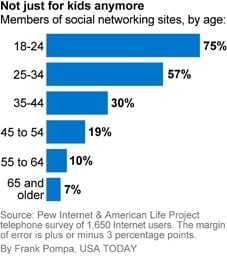
Pew Internet & American Life Project researcher Amanda Lenhart reports in Adults and Social Network Websites that the number of adult Internet users who have taken up social networking has more than quadrupled since 2005. (Chart from USA Today.) This isn’t surprising if you consider the way conversations have moved toward social media as a marketing tool in lieu of a mere social connection with friends.  Networks have properties that defy traditional linear ways of thinking about market reach and targeting users, so growth should follow exponentially.

In October, another Pew researcher reported on how the Internet and cell phones have become central components of family life.  It’s not possible to have digital connectivity central to family life without adults engaging in digital networks.

We can think about media devices as a progression, using a lifespan approach to technology adoption.  First you crawl, then you walk….Cell phones may not be the first thing that comes to mind in a social network, but they are essentially social networking devices.  Once someone starts using a handheld device for connections beyond making and receiving calls,  it’s a much shorter step to Twitter.  I’m curious about the motivation for change and how most adults experience the progression.  How people conceptualize and rationalize their adoption of technology would tell us a lot about the next round of integration and how we can provide effective technology applications to users.


  • Facebook
  • Twitter
  • Reddit
  • LinkedIn
  • E-Mail

About The Author

Pamela Rutledge, PhD, MBA is the Director of the Media Psychology Research Center. A consultant, author, speaker, and professor, she consults on a variety of media projects developing audience engagement and brand storytelling strategies.

Comments

  1. Dancing BAG Lady
    January 17, 2009 at 9:29 pm ·

    I just had my first workshop today. In my feedback survey I asked if they were involved with social networking or blogs and all commented yes.

    Their ages ranged from 28-65. They all commented that they would be interested in joining a social network to stay in contact with each other.

    they did express a concern with losing face to face contact with women. With all of our committments I have found social networking a way to easily supplement otherwise lost contact.

    My experience is that my social networking has allowed me expand my horizons and connect with people I would never had with it.

    Of course balance is key.

  2. Gabrielle
    January 20, 2009 at 3:51 am ·

    It’s interesting that I am reading this today, I have been pondering all the networking avenues over the last few days. Although we spend money on advertising, we have relied more on networking to get the word out about our sites and products. The hours are endless and thus far non profitable. Formerly I had a job where all forms of connectivity were required for me to be effective and found if necessary. But, when I came “home” to “work” several years ago, I not only gave up my cell phone, we turned off our regular phone for a year, just to sever many peoples need to contact me rather than their new leader. This was drastic, but it taught me that I did not have many “real” relationships. Over the last 5 years, I have promoted that we as friends actually see one another and spend time doing real tasks as a community. I do not desire a cell phone EVER again, but it is inevitable. I would like to know if social networking is making us more or less healthy has people in those and other relationships, keep me posted!

  3. PopArtDiva
    January 22, 2009 at 5:32 pm ·

    I was just discussing Twitter v. MySpace with friends last night – the younger networkers seem to like the antics at MySpace whereas the older surfers like the mini business/network/connection of Twitter.

    It was funny – just this last Sunday the ABC show Brothers and Sisters was talking about Twitter and social networking – wow, the Twitter PR peeps must be working overtime, lol.

Leave a reply

Your email address will not be published. Required fields are marked *

This site uses Akismet to reduce spam. Learn how your comment data is processed.

FOR THE PRESS

Dr. Pam Rutledge, media psychologistDr. Pamela Rutledge is available to reporters for comments on the psychological and social impact of media and technology on individuals, society, organizations and brands.  pamelarutledge@gmail.com

SEARCH THE SITE

RECENT POSTS

  • The Legacy of Daytime Talk Shows Lives in Your Feed
  • Oprah's High Road: Diverging Paths in Daytime Talk Shows
  • Daytime Talk Shows: Why We Couldn’t Look Away
  • FAFO Parenting: Letting Kids Learn the Hard Way
  • Meta Is Using Your AI Chats to “Personalize Your Experience”

MEDIA PSYCHOLOGY RESEARCH

The Media Psychology Research Center (MPRC) is an independent research organization directed by Dr. Pam Rutledge.  Read about MPRC at www.mprcenter.org.

CONSULTING PROJECTS

Dr. Rutledge consults on a variety of media projects using psychology to translate data into human behavior for powerful results.

  • Parenting in a Digital World webinar series
  • Persona Development for audience segmentation
  • Fan and Audience Engagement: Identifying audience narratives to satisfy needs
  • Brand Storytelling: Supercharging brand meaning

RECENT POSTS

  • The Legacy of Daytime Talk Shows Lives in Your Feed
  • Oprah's High Road: Diverging Paths in Daytime Talk Shows
  • Daytime Talk Shows: Why We Couldn’t Look Away
  • FAFO Parenting: Letting Kids Learn the Hard Way
  • Meta Is Using Your AI Chats to “Personalize Your Experience”

SEARCH

Content copyright Pamela Rutledge 2026.