DR. PAM | MEDIA PSYCHOLOGIST
THE PSYCHOLOGY OF DIGITAL BEHAVIORS
  • Home
  • Blog
  • About
    • About Dr. Pamela Rutledge
    • Media Psychology
      • What Is A Media Psychologist?
      • 8 Reasons Why We Need Media Psychology
      • Careers in Media Psychology
      • Example Careers in Media Psychology
      • Media Psychology at Fielding Graduate University
      • Positive Media Psychology
    • MPRC
      • Media Psychology Research Center
    • Media Psychology Review
  • Consulting
    • Speaking & Consulting
    • Audience Engagement: Why Use Personas?
      • How to Build a Persona
    • Adapting to Change
    • Transmedia Storytelling
      • Storytelling Across Platforms
      • Transmedia Storytelling Starts with the Power of Story
      • Our Transmedia World
      • Transmedia Case Study: The Three Little Pigs
      • Transmedia Storytelling Workshop
  • Story Power
    • Brand Storytelling
    • Storytelling: Brands, Entertainment & Organizations
      • Storytelling for Organizations
      • Core Story: Case Study
  • In the News
    • Press Quotes & Interviews 2022-2025
    • 2021-2019
    • 2018-2016
    • 2016-2017
    • 2015-2013
    • 2012 & EARLIER
    • Video Interviews & Webinars
  • Resources
    • Mindful Media & Digital Literacy
      • Positive Media Psychology
      • Benefits of Video Games Part 1
      • Benefits of Video Games Part 2
      • Benefits of Video Games Part 3
      • Becoming Mindful: Exercises
      • Mindful Media Journal
    • Academic Materials
      • Media Psychology Syllabus 2021
      • Media Psychology Syllabus 2012
      • Media Psychology Syllabus 2015
    • Articles
      • Persuasion & Augmented Reality
      • Psychology of Transmedia Engagement
      • Theories of Attention
      • The Psychology of Color
      • Website Design: How to Use Psych Theory
      • Data Strategy: Listen to Your Consumers’ Stories
      • The Psychology of Story
  • Archives
  • Contact
DR. PAM | MEDIA PSYCHOLOGIST
  • Home
  • Blog
  • About
    • About Dr. Pamela Rutledge
    • Media Psychology
      • What Is A Media Psychologist?
      • 8 Reasons Why We Need Media Psychology
      • Careers in Media Psychology
      • Example Careers in Media Psychology
      • Media Psychology at Fielding Graduate University
      • Positive Media Psychology
    • MPRC
      • Media Psychology Research Center
    • Media Psychology Review
  • Consulting
    • Speaking & Consulting
    • Audience Engagement: Why Use Personas?
      • How to Build a Persona
    • Adapting to Change
    • Transmedia Storytelling
      • Storytelling Across Platforms
      • Transmedia Storytelling Starts with the Power of Story
      • Our Transmedia World
      • Transmedia Case Study: The Three Little Pigs
      • Transmedia Storytelling Workshop
  • Story Power
    • Brand Storytelling
    • Storytelling: Brands, Entertainment & Organizations
      • Storytelling for Organizations
      • Core Story: Case Study
  • In the News
    • Press Quotes & Interviews 2022-2025
    • 2021-2019
    • 2018-2016
    • 2016-2017
    • 2015-2013
    • 2012 & EARLIER
    • Video Interviews & Webinars
  • Resources
    • Mindful Media & Digital Literacy
      • Positive Media Psychology
      • Benefits of Video Games Part 1
      • Benefits of Video Games Part 2
      • Benefits of Video Games Part 3
      • Becoming Mindful: Exercises
      • Mindful Media Journal
    • Academic Materials
      • Media Psychology Syllabus 2021
      • Media Psychology Syllabus 2012
      • Media Psychology Syllabus 2015
    • Articles
      • Persuasion & Augmented Reality
      • Psychology of Transmedia Engagement
      • Theories of Attention
      • The Psychology of Color
      • Website Design: How to Use Psych Theory
      • Data Strategy: Listen to Your Consumers’ Stories
      • The Psychology of Story
  • Archives
  • Contact
Jan 25

Guilt-Free Binge-Watching: New Consumptions Patterns

  • January 25, 2020
  • Pamela Rutledge
  • No Comments

Canvas8 Expert Outlook 2020

As part of Canvas8’s Expert Outlook 2020 Report, I comment on the cultural and behavioral drivers impacting media and consumer behavior in the year ahead. I always enjoy contributing to Canvas8’s yearly Expert Outlook which brings together 42 impressive experts across 14 sectors. This year’s theme is HEAR ME!  Media consumers are getting smarter, devices more personal and control is in their hands. #Bingewithoutshame.
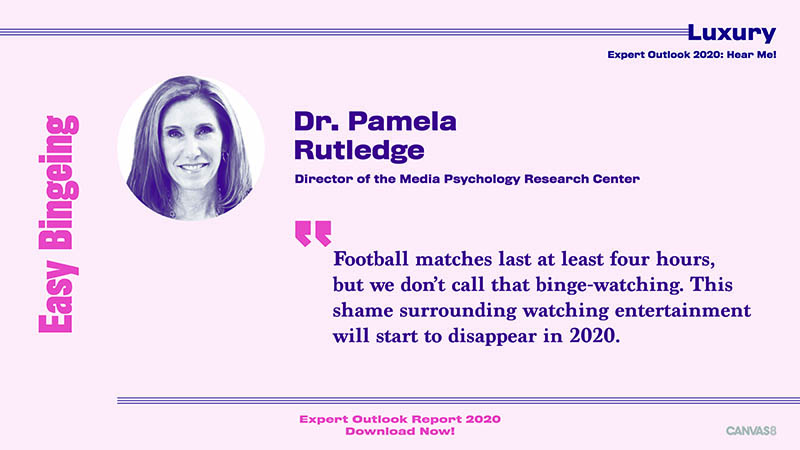
Dr. Pamela Rutledge

Media Consumption: Personal Choice Not Guilty Pleasure

People are short on time and want more personalized media experiences. Mobile has become the go-to source for entertainment, so media companies will look to curate linear narratives for the small screen. This has implications for production quality, camera angles and sound. In addition, it implies that the concept of “snackable content” so big in content marketing will move to entertainment channels, increasing the interest in more chunk-able segments.

This will be driven by new technologies that can increase optimization for mobile, better access to streaming, smarter devices, and an increasing ability to get both short- and long-form content. All of this means that people will have more control over what they watch and producers will scramble to get their share. Attention is limited by time which is a finite resource. Each person only has 24 hours in a day (so far.)

The logical extension of what we see in content marketing and the success of YouTube is a new form of content that is chapter-driven rather than episodic. Think ten-minute chunks instead of a 30-minute story arc so that people can watch things on public transportation or while they are waiting in line.

It also means people can better control their consumption habits. As a result, people won’t internalize all this misplaced and societal “guilt” about their media consumption choices. Watching more than one episode of a program has been saddled with the pejorative label, binge-watching. In some academic literature, binge-watching is two or more episodes of the same show. It’s ironic that we say that’s binge-watching but if you change the channel, it’s not counted. Football matches last at least four hours, but we don’t call that binge-watching. The implicit assumption in the construct of “binge-watching” is the loss of control.

As people begin to consume a more time-varied diet of media, it will increasingly emphasize the role of intention and personal control that differentiate consumption patterns and the range of psychological experience. (Yes, there are BENEFITS in entertainment and fandom. It’s okay to have fun.) The generalized shame surrounding entertainment media will start to disappear in 2020.

Read the full report here: https://bit.ly/2RIlSRk #expertoutlook2020
  • Facebook
  • Twitter
  • Reddit
  • LinkedIn
  • E-Mail

About The Author

Pamela Rutledge, PhD, MBA is the Director of the Media Psychology Research Center. A consultant, author, speaker, and professor, she consults on a variety of media projects developing audience engagement and brand storytelling strategies.

Leave a reply

Your email address will not be published. Required fields are marked *

This site uses Akismet to reduce spam. Learn how your comment data is processed.

FOR THE PRESS

Dr. Pam Rutledge, media psychologistDr. Pamela Rutledge is available to reporters for comments on the psychological and social impact of media and technology on individuals, society, organizations and brands.  pamelarutledge@gmail.com

SEARCH THE SITE

RECENT POSTS

  • The Legacy of Daytime Talk Shows Lives in Your Feed
  • Oprah's High Road: Diverging Paths in Daytime Talk Shows
  • Daytime Talk Shows: Why We Couldn’t Look Away
  • FAFO Parenting: Letting Kids Learn the Hard Way
  • Meta Is Using Your AI Chats to “Personalize Your Experience”

MEDIA PSYCHOLOGY RESEARCH

The Media Psychology Research Center (MPRC) is an independent research organization directed by Dr. Pam Rutledge.  Read about MPRC at www.mprcenter.org.

CONSULTING PROJECTS

Dr. Rutledge consults on a variety of media projects using psychology to translate data into human behavior for powerful results.

  • Parenting in a Digital World webinar series
  • Persona Development for audience segmentation
  • Fan and Audience Engagement: Identifying audience narratives to satisfy needs
  • Brand Storytelling: Supercharging brand meaning

RECENT POSTS

  • The Legacy of Daytime Talk Shows Lives in Your Feed
  • Oprah's High Road: Diverging Paths in Daytime Talk Shows
  • Daytime Talk Shows: Why We Couldn’t Look Away
  • FAFO Parenting: Letting Kids Learn the Hard Way
  • Meta Is Using Your AI Chats to “Personalize Your Experience”

SEARCH

Content copyright Pamela Rutledge 2026.